



We would like to say at top that we believe that the work NYC-DSA Tech Action Working Group has done and continues to do is invaluable, and encourage anyone who wants to organize against the tech oligarchy to join, to contribute time and energy to immediate efforts to ensure workers are protected, and to attend the Working Group’s action on 10/5 in relation to the Council hearing on AI, or submit testimony. We welcome corrections and feedback to this article by members of Tech Action Working Group’s Organizing Committee, and look forward to continuing working with them on ensuring that AI companies are held accountable.
Summary
The NYC-DSA City Convention Stop the AI Arms Race! outlines a series of principles on Artificial Intelligence and calls for SIO legislative action for a pause on AI capabilities research, protecting workers from automation, and democratic control of the technology. It then defines a chapter-wide deliberative process, hosted by Tech Action Working Group, to define a Chapter Priority Campaign on AI, recognizing that there is not yet an organization-wide consensus on what aims should be prioritized.
An amendment has been proposed by some members of Tech Action Working Group Organizing Committee.
We will not be accepting the amendment to the resolution Stop the AI Arms Race! as friendly. The amendment strikes language recognizing the threat of mass automation from AI and robotics and catastrophic risk from highly capable AI systems, predicated on the notion that there is consensus within Tech Action Working Group on such matters. There has been no deliberative process or vote to discover that consensus, and Tech Action Working Group has not held membership meetings or other bodies where this question could be discussed. The amendment also proposes to scrap the resolution’s process for determining a Chapter Priority Campaign on AI, instead shifting to an existing process to propose a campaign for Tech Action Working Group, entirely located within the Working Group, with unclear procedures and limited access to general DSA membership. This process, which may conclude before Convention, would likely be moot by the time the amendment is considered at our most democratic body.
Meanwhile, a host of Socialists-in-Office and progressive coalition partners have called for legislation protecting workers from automation and the public from catastrophic risk. As the public and our coalition converge towards the broad objectives outlined in the original resolution, we cannot afford to let this opportunity to deliberate on and then organize for a socialist agenda on frontier Artificial Intelligence and the threat of mass automation and the radical concentration of power.
The NYC-DSA Convention resolution Stop the AI Arms Race! has generated much debate within our organization. 180 NYC-DSA members have co-sponsored the resolution, demonstrating a broad, chapter-wide desire for democratic deliberation on socialist orientation towards Artificial Intelligence and for DSA to mobilize around popular demands to ensure workers are not disempowered, immiserated, or harmed by the irresponsible oligarchs developing this technology.
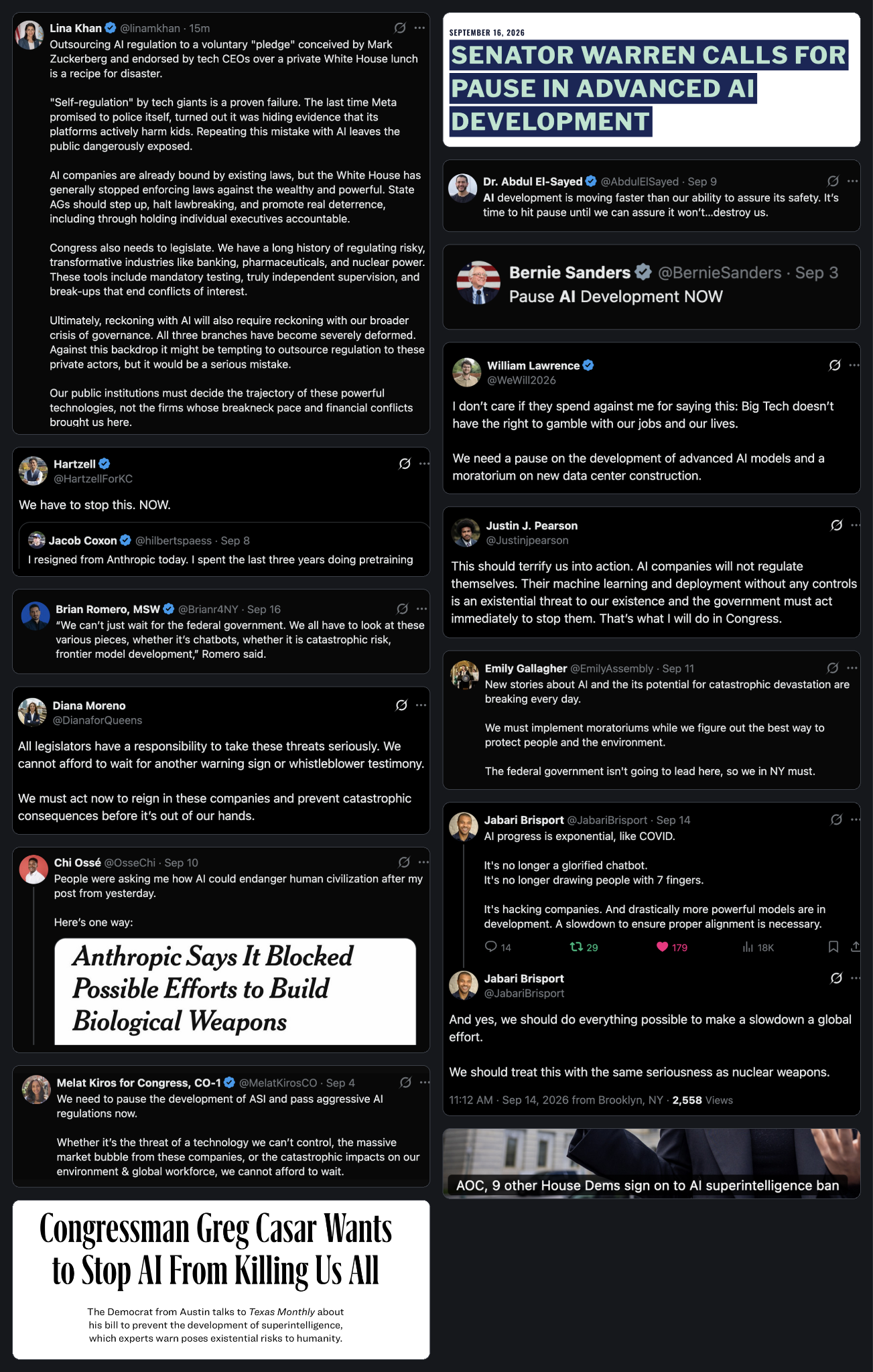
This resolution does not exist in a vacuum. After the Hugging Face hack and other recent events, Socialists-in-Office and progressive allies have come out in force for stronger frontier AI regulations and protections for workers from AI-driven automation. We present expressions of support for mitigating the catastrophic risks posed by AI from Melat Kiros, Chi Osse, Jabari Brisport, Diana Moreno, Emily Gallagher, Brian Romero, Hartzell Gray, Justin Pearson, Will Lawrence, Bernie Sanders, Abdul El-Sayed, Elizabeth Warren, and Lina Khan to name a few. AOC has signed on to the Sanders-Casar bill banning Superintelligence1 and imposing a pause on frontier AI capabilities research, which with modifications we view as possible model legislation for New York State.
Furthermore, the salience of this issue has radically accelerated. The American people are increasingly worried about the threat AI poses to their job, their dignity, and their lives. 74% of Americans do not trust political figures who claim AI will not cause widespread job loss. Two out of three Americans believe there is at least a moderate risk that “advanced AI will destroy humanity.” If we do not provide a response fit for the moment, informed by a scientific accounting of AI capabilities and risks, orienting these concerns towards democratic socialism, this space will be filled by the hand-wringing of the AI CEOs, the denialism of the Trump administration, and the vacuousness of the Democratic establishment.
While Tech Action Working Group has long engaged in fantastic and necessary work, as we stated in our article in Geese magazine introducing the resolution,
We believe that this issue is much bigger than one working group, and will require a society-wide response. It would unduly burden the Tech Action Working Group to assume they ought to be responsible for all areas of this response, including labor policy, taxation, environmental protection, and so on. The broad orientation of NYC-DSA towards AI ought to be decided by our most democratic body - Convention, ushering in chapter-wide deliberation.
We encourage anyone interested in organizing for a socialist agenda on AI and for the protection of the working class from the AI industry’s plan to disempower them to join TAWG and participate in real actions and legislation.
Members of the Tech Action Working Group OC, hereafter TAWG OC, have submitted an amendment to the resolution. Unfortunately, we will not be accepting this amendment as friendly. It removes statements from the resolution text aligned with socialist principles, reduces the broad democratic character of the process proposed for drafting a chapter-wide AI Priority Campaign to an internal TAWG campaign, and eliminates language calling for socialization and safety regulations, in contestation with the principles of democratic socialism, our national program, and the concerns of SIOs, progressive allies, and public opinion.
Amendment Motivation
The amendment, written by some members of TAWG OC, concurs with the identification of the enemy: “a billionaire class using AI to concentrate wealth and disempower workers”, but states that we “adopt the same class’s story about what AI can do.” This charge is hard to square with the amendment’s own edits, which strike our recognition that venture capitalists and the Trump administration deny catastrophic risks and mass automation outright. To them, we add Nvidia CEO Jensen Huang, who referred to catastrophic risk as “doomsday scenarios”, and Vice President Vance, who said that Americans “should not be scared of anything.”
We acknowledge that of course Sam Altman and Dario Amodei, seeking to forgo both rigorous regulation and policies that are a greater threat to them and their investors such as a complete pause on AI development or socialization, are working towards weak regulations and recognize catastrophic risks publicly. However, as we have written about before, this is nothing but a sop to public and scientific concerns, as well as worries among their employees. As all veterans of the climate movement know, oligarchs, whether in Silicon Valley or East Texas, are perfectly capable of publicly expressing concern about the existential harms posed by their project while seeking to insulate themselves from real public control. British Petroleum was not spreading ‘hype’ when it engaged in its ‘Beyond Petroleum campaign’, and neither was OpenAI when it released its empty framework to protect children. Anthropic and OpenAI consistently recognize current harms, but promise that they will self-regulate or water down legislation through their lobby. To equate worrying about catastrophic risk with buying a Silicon Valley narrative is to lump hundreds of DSA comrades, Senator Bernie Sanders, Chi Osse, and 60% of the American public into the same bucket as Sam Altman and Elon Musk. We believe this equivalence is a great impediment to organizing a mass political socialist pole around AI.
The drafters state that the Working Group was already developing a priority campaign to be launched as soon as possible, which we discuss further below.
We appreciate TAWG OC’s organizing on AI in the past years, especially in organizing tech workers and a state data center moratorium. However, we disagree with their notion that risks of loss of control are entirely a mechanism of justifying bloated valuations. Furthermore, we think the effort to push back on concern over AI risk, as reflected by the amendment, is counterproductive.
Our primary disagreement, however, comes from the claim that “the Working Group has already come to consensus through our organizing.” We would like to contest the idea that consensus exists within TAWG. More importantly, TAWG currently has no mechanism through which consensus could be established.
There are many members of TAWG, and many members of NYC-DSA broadly, who concur with the resolution’s analysis, or who are sympathetic. There is no universal opinion held among membership on this matter.
By their bylaws, TAWG is mandated to “Host regular membership meetings at least one a month.”, “conducted electronically” where “committees are expected to provide updates on their work”, a “summary of actions taken at most recent OC meeting” should be on the agenda, and “any Voting Member may raise an issue for discussion.” These meetings, crucial for maintaining engagement and member democracy and for ensuring a transparent OC, have not been held since 3/11/26, before the election of the current OC. This is verifiable by observing the NYC-DSA calendar website as well as their own website calendar, which notably does not include the committee meetings that constitute a majority of the activity open to membership and are the site at which organizing around consensus would occur. OC members have told us the meetings were discontinued because they did not produce much that was actionable. Members of OC have also stated that the general chat of TAWG is not suitable for discussion of AI capabilities and risks, or general questions regarding socialist orientations on technology. This has left no formal mechanism for WG-wide democratic discussion on AI capabilities and risks or member motions for strategic orientation.
To re-iterate, the amendment reflects the position of the TAWG OC & its co-sponsors, who are welcome to express their positions. However, there is no basis to conclude that the amendment reflects TAWG’s official consensus on AI capabilities and risks, as such a thing does not exist nor has been voted on by the members of TAWG.
In fact, TAWG’s principles on technology, a document ratified by vote last year, includes as one of its principles “the call to bring critical technological infrastructure under public ownership” alongside a commitment towards “the push towards comprehensive, proactive legislation on digital technology that protects the public from technological harms” with artificial intelligence as a focus area. However, the artificial intelligence focus areas have not been specified, which would require a vote by TAWG members.
By their bylaws, “In matters of the direction of resources, coalition partnerships, and official statements, all efforts must be made to reflect the democratic will of the general membership.” We are not aware of member votes preceding the city and state policy platforms presented to SIOs and CLC, or votes for a series of official statements released. Furthermore, on social media communications, TAWG is committed by their bylaws to “remain politically neutral w/ regard to DSA: cannot be used to support or attack specific tendencies or caucuses, or advocate for political directions not first decided upon by general WG vote.” While there has never been a general WG vote on the political orientation towards AI, TAWG Instagram has posted several pieces of content, including a recent post drafted by OC expressing opposition to safety concerns advocated by several SIOs, and a post opposing the RAISE Act, which all SSIOs voted for.
Finally, our commitment to chapter-wide deliberation and democracy on this critical issue remains. We believe that artificial intelligence, interfacing with all areas of social struggle, from climate, labor, immigration, and technology policy, is not suitably handled by ownership by a single WG, and instead have proposed through the resolution a chapter-wide PC with a deliberative process facilitated by TAWG as host, collaborating with all parts of the chapter interested in organizing for whatever objectives emerge from a wide democratic discussion on priorities, which we hope might include such gains as expanded unemployment insurance, a 4-day workweek, and safety regulations.
Whereas
While we recognize it is at baseline unusual for the whereas text to be substantively amended, we feel that the drafter’s amendments are revealing in the disagreements we have, and would prefer to be resolved through public debate at Convention and through the process outlined in the resolution.
The following clauses are struck:
i) WHEREAS, the leading AI companies are racing with the intent to automate AI research itself, training AI that could autonomously train even more capable AI models.
One does not have to concur with the scientific possibility of recursive self-improvement to recognize that this is the objective of the AI companies. As we recognize in the clause below, should this not be possible, we would likely concur with the characterization of the industry as possessing inflated valuations. However, the statements of all CEOs of all frontier AI companies, frontier lab company employees, regulators, third-party evaluators and investigators, consistently state that the AI companies are racing to automate AI researchers, which could present considerable dangers to labor and the public.
ii) WHEREAS, the strategy of the AI industry is predicated on achieving this objective; rapid advances in AI capabilities are likely the only path towards meeting their financial obligations. Therefore, they have overwhelming incentives to continue this process. While the feasibility of their objective is an open scientific question, their success would culminate in the development of AI agents more capable than human beings at most or all tasks.
We do not understand the opposition to this clause, which has considerable overlap with the drafters’ analysis of the financial situation of the industry and with the statements of SIOs and progressive coalition organizations.
iii) WHEREAS, the unabated advance of AI and robotics in private hands could expose workers to mass automation, unmooring capital from labor and accelerating the concentration of power and wealth into the hands of a few.
This is the objection we find hardest to understand. The vast majority of Americans are deeply concerned that AI and robotics will enable the mass automation of their work, driving them into immiseration and disempowerment. Furthermore, socialists have traditionally been concerned with automation without ensuring the benefits and control accrue to the working-class. If anything, this is one of the central components of our political pole. Worries over mass automation also generate a political permission structure to enable dramatic structural reforms, with Americans being much more likely to support 4-day workweeks, social wealth, co-determination, jobs guarantees, employee ownership, wage insurance, and other socialist demands in the context of AI-induced job automation. Why NYC-DSA ought not to recognize this threat, in our view the central threat posed by AI, is unclear to us, and we invite the drafters to express their reasoning at Convention and in public fora.
iv) WHEREAS, AI companies are attempting to develop highly capable AI agents while failing to ensure autonomous systems reliably pursue the goals of human users. Without proper guardrails, negligence of the industry creates the potential for loss of control of AI agents to cause catastrophic harm.
v) WHEREAS, Senator Bernie Sanders wrote in his open letter to AI CEOs in August,...
These two clauses, which state a recognition of the harms of loss of control, as well as providing a statement from Senator Sanders on the topic, are struck. Given no substitute language is proposed, we would welcome clarity on what exactly the drafters find objectionable about these sections. For our part, we think the risk is real.
Since the drafting of our resolution, tens of thousands of AI security incidents are now under investigation. While many of these incidents occurred months ago, only recently have independent investigators uncovered the scope at which AI models trained by companies like OpenAI have hacked targets as large as the digital infrastructure of Australia, Canada, and the US and as small as a chemistry wiki built by a high school teacher. When DSA members and electeds express concern with threats of this kind, such as Chi Osse’s recent push for legislation to prepare NYC against AI-assisted cyberattacks, they are acting reasonably.
Progressive organizations have also expressed concerns with catastrophic risks, including data center coalition partner Food and Water Watch and the Working Families Party. Our approach is intensely coalitional. One does not have to agree with any specific threat AI poses. All the resolution text commits us to is generally identifying the possibility that AI systems, whether in a loss of control incident produced by the gap between user intentions and agent actions as well as the negligent cybersecurity practices of the AI companies, or in the hands of bad actors, could cause significant harm to the public.
vi) WHEREAS, the Trump administration and allied right-wing billionaires consistently deny risks from AI and tar those who express concerns about the accelerating capabilities of AI models as extremist traitors to American national security interests. Venture capitalist Marc Andreesen has stated frontier AI regulations are “a form of murder”. Former White House AI-Czar David Sacks said AI safety was the “new climate change”, given all of the “Hollywood storytelling” involved.
In the context where DSA may be running a Presidential campaign, or races in red districts, we believe it is important that NYC-DSA call out the Trump administration and the oligarchy’s incredibly unpopular and dangerous views on this issue.
vii) WHEREAS, recognizing the risks presented by loss of control of AI agents does not distract from other current harms such as algorithmic discrimination, surveillance, AI-driven job displacement, and the environmental and energy costs imposed on communities by data center construction.
As we wrote in Geese,
Q: Does recognizing catastrophic risk distract from current harms?
This is a fair concern, but I would raise two notable points of response.
The first is that there is no evidence that worrying about future catastrophic harms or job automation decreases concern with other matters. I strongly believe that all of these threats come from the same bad actors - the billionaire owners of the frontier AI companies, and thus a broad coalition across all those impacted by technology is an absolute necessity.
Second, the harms entailed by the continuation of a process driven by unbridled capitalist competition are not to be ignored. One would not discard the catastrophes imposed by climate change in a decade due to those imposed now. We must not act until it is too late. We must not wait to have guardrails on models until release, but impose public control over the training process itself. We cannot sit by and act defensively until millions are out of work. Socialists ought to organize and agitate now, as to be at the forefront of the political struggle over AI, at the ready, with a policy agenda capable of meeting the moment.
Resolved: Priority Campaign Process
This is where the most substantive amendments have been proposed. This clause is intended to create a process available to the whole of the chapter to deliberate on a Priority Campaign on AI, with meetings to discuss various aspects of the problem. The amendment removes this mechanism, instead replacing it with TAWG’s internal process for deciding a Working Group campaign, thus removing the pre-campaign nature of the original resolution and diluting the democratic character of the mechanism.
The amendment text proposes to replace the “three public assemblies… for discourse and debate on relevant questions, with a motion … decided upon by a majority vote of the members of Tech Action Working Group” with “a forum … to discuss Working Group … priority campaign proposals generated in Working Group meetings leading up to the forum.”
We note three important issues with this text.
i) We believe that as AI is an issue with mass public and SIO interest, a Chapter Priority Campaign is the appropriate organizing tool. The amendment substitutes the PC with a WG priority campaign. There is an effort in TAWG to centralize their disparate focuses into a single campaign. We agree with this proposal, and have been working within the TAWG priority campaign subcommittee to assist in drafting. This does not conflict and is not duplicative with a broader chapter PC calling for policies and collaborating with SIOs that TAWG’s eventual campaign does not directly interface with. Our vision is one that sees extensive collaboration between WGs, especially Labor, in the drafting of demands that are outside of TAWG’s traditional scope. We would love to see TAWG focus its organizing efforts to policies deliberated on in TAWG, while the PC orients itself to non-competing objectives with a different, but overlapping base.
ii) While the original resolution text spells out a clear process for democratically deciding upon the character of the assemblies, the amendment text simply calls for a forum to exist. It is unclear how the agenda will be decided. If it should be OC, we disagree with the lack of democratic input into the process. If it should be the campaign subcommittee, it is unclear how disagreements on agenda would be resolved.
iii) We believe that multiple meetings are required to scope our agenda, given the complexity of the matter.
Furthermore, the amendment restricts the vote on a campaign to “priority campaign proposals generated in Working Group meetings leading up to the forum”. Given that the process within TAWG’s priority campaign doc is that “3-4” ideas for a PC will be sent to a vote of membership, it is unclear how the 3-4 proposals will be decided upon. There are currently 9 campaign proposals in the document planning proposals within TAWG priority campaign subcommittee. We believe that should this process occur, all proposals ought to be sent to a vote.
The amendment’s proposed forum attendance is restricted to those who have “participated in one Working Group action prior to the forum.” For voting eligibility, the amendment states that “A priority campaign proposal will be selected by rank choice vote with voting eligibility having participated in one Working Group action a year prior to the vote.”
There are several objections to these restrictions.
i) We disagree with the notion that participation in the forum ought to be restricted to TAWG members as defined here. It would foreclose perspectives from those primarily involved in labor, eco-socialist, or immigration organizing, as well as those whose attention is brought to AI by recent events who have not yet been involved in organizing efforts. Voting aside, discussion and attendance, in our view, should be open to all DSA members. Unlike EWG endorsement fora, this is not a politically sensitive matter requiring restriction to the press or potential agitators.
ii) As TAWG has not held membership meetings as of recent, to our knowledge does not maintain centralized records of attendance to subcommittee meetings or other actions, it may be difficult for many interested members to demonstrate eligibility. This concern is intensified by the fact there have not been membership votes held in TAWG in at least 6-months. OC is capacity constrained on onboarding new members. While we have expressed interest in assisting OC with the onboarding process due to recent intense interest in organizing around AI, these factors still artificially constrain the voting membership for the selection of a campaign.
iii) As One Big Election is not yet in force, the definition of membership is that outlined in the TAWG bylaws. Stop the AI Arms Race! uses the definition of membership from the TAWG bylaws, which distinguishes between voting and general members, but provides all members with the ability to vote on a motion if they attended the membership meeting where the motion was discussed. We are open to clarification on voting eligibility, and will refrain from attempting to impose a decision mechanism on the internal TAWG campaign decision process, but maintain that permitting membership meetings would have allowed this matter to be resolved.
iv) There are many DSA members seeking to organize for demands that TAWG OC has not yet articulated or has openly stated opposition to, as well as many activists who would join DSA to organize around AI. We view this issue as a critical opportunity for base-building and expanding the organizing capacity of DSA by including people who have not yet been fully plugged into the deliberative process for a campaign. This amended mechanism eliminates that opportunity.
v) Finally, it is possible that TAWG will complete its internal campaign proposal process before the Convention, making the vote at Convention on this text moot.
We encourage any NYC-DSA member interested in contributing to TAWG’s internal campaign, or in the process of deciding the character of the deliberative assemblies in Stop the AI Arms Race!, or of participating in the many fantastic organizing efforts currently occurring in TAWG, around the 10/5 Council hearing on AI, data center moratoria, or emerging efforts at political education on technical matters, to join TAWG and participate. Once you join, you will have to specifically request onboarding onto the Policy & Advocacy committee, Priority Campaign committee, or Comms. We encourage anyone who wants to shape this work to join and contribute.
Resolved: Calls to Action
Several changes to the rest of our resolved text, which focused on calls to action are proposed.
i) NYC-DSA calls for SIOs to advance legislation for a moratorium on the construction of data centers for AI training runs.
In spirit, we accept this component of the amendment as friendly. We would accept an amendment changing the clause to the following:
NYC-DSA calls for SIOs to support and advance the NYS Data Center Moratorium (S.9144).
ii) NYC-DSA calls for SIOs to advance legislation, informed by the deliberative process described above, imposing guardrails on the training of AI models rather than waiting for negligent AI companies to deploy unsafe models to the public. Such regulations could include mandatory state pre-deployment auditing, stronger whistleblower protections, or any other policy designed to protect our communities from catastrophic risksharm.
This clause is not intended to foreclose regulations on the deployment of AI models, which is already being pursued, but on training. Harms to the public can emerge from the training of internally deployed AI models at the AI companies themselves, and regulation on this subject is greatly needed. While we recognize that ‘catastrophic risk’ is in some ways an imperfect term, the clause is intended to specifically call for frontier AI safety regulations and the strengthening of public infrastructure’s robustness to cyberattacks, and removing that language dilutes its meaning to generally call for the regulation of AI.
iii) NYC-DSA calls for SIOs to fight for reforms, informed by the deliberative process described above, strengthening the power of labor to determine the course of the transformation of work, and for the democratization and socialization of AI.
This is an area of disagreement within DSA and within TAWG. Thus, we would greatly appreciate discussion of this matter at Convention and in other public fora. Given how broad the resolution text is, not calling for any specific socialization mechanism, we are opposed to outright rejection of the very idea of democratizing or socializing the technology.
As we have written in the past,
At the same time, socialists have a unique opportunity to push for what must be one of the central goals of our movement, as detailed in our platform - “public ownership of the largest corporations and essential industries to ensure democratic control and accountability to the people”. 69% of Americans would concur with seizing 50% of the ownership of the frontier AI companies. There is a wide debate to be had about the shape of socialization, and whether we mean forcing AI research into the public domain or outright nationalizing the entire sector, it is clear that the overwhelming majority of the American people recognize that a technology trained on the common corpus of human art and text, poised to transform the character of work, ought to be held in common rather than by billionaires.
When the people are the masters of artificial intelligence rather than its victims, we will be able to decide to direct it towards useful ends, to the curing of diseases, to the automation of unwanted drudgery.
With AI under democratic control, we will decide what activities ought to be left to human hands, exalted creative tasks that make life meaningful, and which can be automated to expand flourishing and freedom. DSA members may have quite different views on where those lines lie, with some wishing to ban the technology entirely. Regardless, the point is that those decisions will be ours, not Sam Altman’s, not Dario Amodei’s, not Elon Musk’s. Only with socialization and democratization can AI be deployed towards creating a life of endeavor and discovery, rather than an inhuman, inegalitarian mass-surveillance hellscape.
We believe that New York City Democratic Socialists of America ought to call for democratic socialism, which at base is founded in extension of democratic control and autonomous organization to all areas of social life, stripping from capital the basic mechanism for its domination, the private ownership of capital. We ask those who oppose this clause why AI should be exempt from a demand our platform makes of essential industries generally; this is the type of conversation we seek via chapter-wide deliberation.
iv) NYC-DSA calls for an immediate international halt on frontier AI capabilities research. to stop unchecked speculation by the AI industry. All AI regulation, frontier or otherwise, must be done by government bodies entirely independent from AI companies to prevent regulatory capture by the same companies who tout themselves as the only ones capable of understanding their “super intelligent” technology.
We disagree with the framing that the only purpose for a halt on frontier AI capabilities would be stop speculation, though we concur with the idea that should the sector be an asset bubble, that a pause would deflate it. In principle, we also agree with the notion that AI regulation ought to be done by government bodies, but we have contentions with this proposed wording, and would accept a friendly amendment that added such a clause, without foreclosing intermediate legislation that utilizes third-party evaluators if legislative majorities or executive approval, at a State or Federal level, for public evaluators are not attained. Our position is always that the public ought to be steering the progression of the technology.
Conclusion
NYC-DSA TAWG has done genuinely incredible work over recent years. They have worked toward the prohibition of data centers, against surveillance pricing and the use of surveillance for immigration enforcement, for the organization of tech workers, and for regulations on some current harms of AI. We bear no ill will toward the drafters of the amendment, or to TAWG. In fact, we are both members of TAWG and are participating in organizing efforts with the drafters as we speak. However, we do not agree with the idea that chapter-wide discussion on the threat from the AI sector should be foreclosed in favor of an internal process. We believe AI does pose catastrophic risks to the public, and that AI and robotics might radically concentrate power in a narrow few capitalists. We regret that this debate has taken on a semi-adversarial character, given the broad agreement on who our enemy is and that this sector cannot be left to its own devices. Such internal arguments distract from the opportunity to take the initiative on AI and mobilize public concern towards victory for the working class, especially on transformative labor reforms long sought by our movement.
The resolution does not deny TAWG’s work, it is simply a statement of principles and a call for a Priority Campaign integrating voices throughout our organization.
At Convention, we are excited for the chance of an evidence-informed debate on the question of NYC-DSA’s strategic orientation towards a transformative technology presenting a once in a generation opportunity for the mobilization of the masses to the project of democratic socialism.
Defined in the legislation as “an AI that exceeds human cognitive performance and capabilities across most domains, or has sufficient capabilities to destroy or disempower humanity, including by overthrowing the federal government.” We believe that this term, alongside the use of ‘cognitive’ abilities, has unfortunate implications regarding problematic and imprecise definitions of intelligence, and prefer definitions that are defined by specific capabilities that can be more precisely evaluated, and wording that does not define some threshold above which recursive self-improvement poses risks. This is an open site of discussion and debate that would occur in the drafting of any similar legislation in NY State.