


AI Safety has attracted thousands of motivated and well-meaning individuals over the past few years, encompassing a broad range of potential threats. Many have chosen to work in this field for technical reasons entirely unrelated to their politics, which are frequently left-wing. Despite how some on the Left may characterize them, safety advocates hold a diverse set of views, debate what risks are most important to prioritize, and frequently critique the behavior of the big AI companies. While some are employed by frontier labs, many do their work in academia or non-profits.
Increasingly, people who work on AI Safety are realizing that making AI go well will require not only technical research, but a mass political movement. I believe we should welcome them and their cause. Here are, in brief, some arguments for that position.
1] We all agree that we ought to minimize the dangers of AI (with some variation in prioritization)
We don’t all need to agree on exactly how dangerous AI is and how quickly those dangers may intensify. But it’s trivially true that systems trained with deep learning are not automatically aligned to the values we want them to have. We should be a big tent on this. If you’re worried about AI-generated bioweapons or the cyber capabilities of current models, great! If you want to organize against AI-powered surveillance, good! Different people will find different domains of this issue energizing, and our efforts will complement each other. I struggle to see how we might benefit from gatekeeping any part of this spectrum.
2] AI Safety is only going to grow as an issue
As attention on this issue has grown over the past few years, the influence of safety-oriented organizations has scaled rapidly. It would be useful to get in early before another political faction dominates the narrative in this domain.
3] AI Safety advocacy complements canonical concerns of AI Ethics
Both AI Safety and AI Ethics agree that we need to think through how we design AI, else it can perpetuate current injustices and even create new harms. When AI Safetyists say they want to make sure AI systems are like helpful assistants that align with our values, surely that scope should include ensuring AI does not perpetuate discrimination or contribute to imperialism. Organized lab workers at Google DeepMind agree—they recently voted to unionize to stop deals with the US Military. These perspectives compliment each other, we should welcome both.
4] Talking about future harms does not distract from current harms
First, a study which shows discussing catastrophic AI risks does not make people less concerned about the immediate harms of AI.
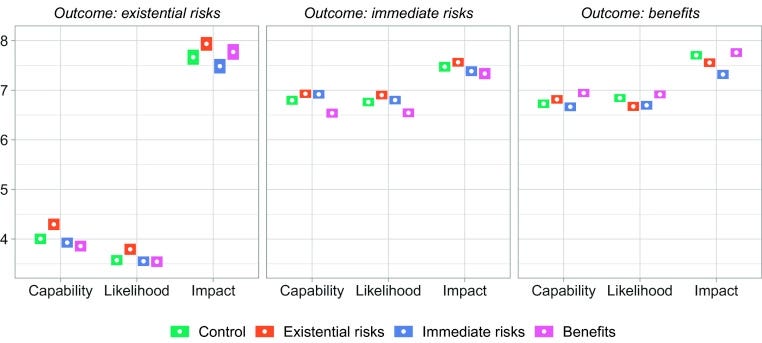
Second, an analogy. One could view AI Safety is to AI Ethics as the climate movement is to the environmental movement. In the case of the latter, the discussion of future climate change has only bolstered the argument to be good stewards of our environment today. While there are arguments over the trade-offs between the two cause areas over, for example, the environmental review process of building clean energy, collaboration between the climate and environmental movements have allowed them to grow in influence more than either could individually. I believe the same positive-sum collaboration could emerge between AI Safety and AI Ethics if we let it.
Preventing loss of of control risk is a complement to ensuring that AI is deployed in a safe and democratic manner that centers human flourishing, granting us a structuring emergency that necessitates political action on a host of adjacent issues to the core AI safety case.
5] Leftists messaging on AI risk would not contribute to a financial bubble
A common counter-argument states that the Left should avoid talking about AI risk to avoid perpetuating the AI industry’s marketing.
Imagine you were one of the few wealthy individuals or institutions on the fence about investing in AI. Think about the reasons you might have to decide to buy or sell AI-related stock. If AOC came out with a statement saying that AI was becoming increasingly dangerous to the public good, and that she’s backing strict regulation or even a federally-enforced pause on capabilities research. Would the Left taking these policy positions make you more likely to invest in AI? Would anything a socialist says cause you to think AI is real? I find it hard to believe AI-skeptical capitalists are waiting on the Left to make their investment decisions.
I’m very skeptical that messaging on the dangers of AI would make for an intensified financial bubble. In fact, such an approach would only increase the perceived likelihood of regulation, which decreases the valuation of AI, if anything.
Who is truly most likely to change their minds about the nature of a technology given a change in messaging from leaders of the Left? Leftists!
6] AI Safety is intuitive and popular
If anything, our refusal to talk about this issue is unpopular. According to polling, most people don’t trust Big Tech to govern this technology themselves. Over the past half-century, sci-fi has primed many to understand “rogue AI” as at least a remote possibility. We lose credibility with our rather convoluted argument to be against common-sense regulation in this specific domain.
7] Embracing safety concerns invites technical people to the Left
Many AI researchers are deeply invested in mitigating the negative outcomes of the technology they’re developing. Given the directional scientific consensus on the likelihood of such outcomes, there are many technically-minded people who view AI Safety as a more salient issue than the general public. While many of these people are otherwise left-wing, some find this issue so important that they have become essentially single-issue voters for candidates who signal awareness of this issue. Acknowledging the legitimacy of their concerns is low-cost and gives these people permission to align themselves fully with the Left.
8] We can use organized AI sector labor to enforce demands
Given how concentrated the development of this technology is and how slow the state has been to develop the proper regulatory framework, AI researchers hold a huge amount of the actual leverage to control the development of AI. The Left should not overlook the opportunity to organize labor in a critical industry like this one by alienating AI Safetyists. A shared commitment to safety would serve as an on-ramp for such a project where traditional issues like pay are not as salient.
9] We can avoid getting hit by AI Safety PAC money
Many AI Safety researchers are set to suddenly become quite wealthy. Ideological entrepreneurs who are opposed to the Left on other grounds are going to leverage our silence on AI risk against us to fundraise for both moderate Democrats and Republicans. Embracing AI Safety neutralizes their ability to credibly raise money from Safety researchers who do not share their underlying partisan motivations.
10] We can leverage pro-safety positions against accelerationist opponents
In the opposite camp, politicians like Ritchie Torres have taken substantial sums of PAC money from anti-regulation groups like Leading The Future, funded primarily by OpenAI and ex-Palantir executives. If we were to be in a primary against such a candidate, embracing AI Safety would not only be popular among voters, it would also permit pro-safety PACs to counter accelerationist spending.
11] Abstinence will allow the Right to define “Safety” Hawkishly
Some on the right use AI Safety as a wedge issue to gain influence over technical specialists. Frequently, they acknowledge AI risks but then pivot to the dangers of letting China build tech that has those same risks. This increases the likelihood of war with China while pulling Safety advocates to the Right. By defining safety on our own terms, we promote international collaboration and cede the Right no easy victories.

Cohen, Harold. AARON Gijon. 2007, Whitney Museum of American Art, New York. Screenshot. Whitney Museum of American Art, whitney.org/collection/works/65557.
