Here is the text with formatting, paragraph breaks, and punctuation cleaned up while preserving the substance:
Cognitive science has a public image problem. As an incredibly recent field of research, there aren’t big unifying theories to arrange popular books around, nor is there a long, uncontroversial narrative of progress. The study of thought lies at the intersection of very disparate fields—biology, psychology, linguistics, computer science, statistics, and more; it’s hard to fault a pop-science book for struggling to cobble together structure from that chaos. And, perhaps worst of all, the field is dangerously close to the category of “self-help.” It’s hard to consider cognitive science without applying it to our own cognition, after all.
And so the rich scientific expeditions into the mysteries of the mind are often compressed into pithy advice or labels we can try on for size. When I think “pop cognitive science,” I think of “how to manage the dopamine rush of phone addiction” or “your brain structure literally changes when you exercise regularly,” or a myriad of other evidence-based oversimplifications that we can’t wait to apply to our own lives. To be clear, I don’t mean to say people shouldn’t be excited to understand their own minds better; scientifically inspired introspection can be a wonderful thing! But the issue arises when people begin to believe that those tidbits are representative of the state of research into thought.
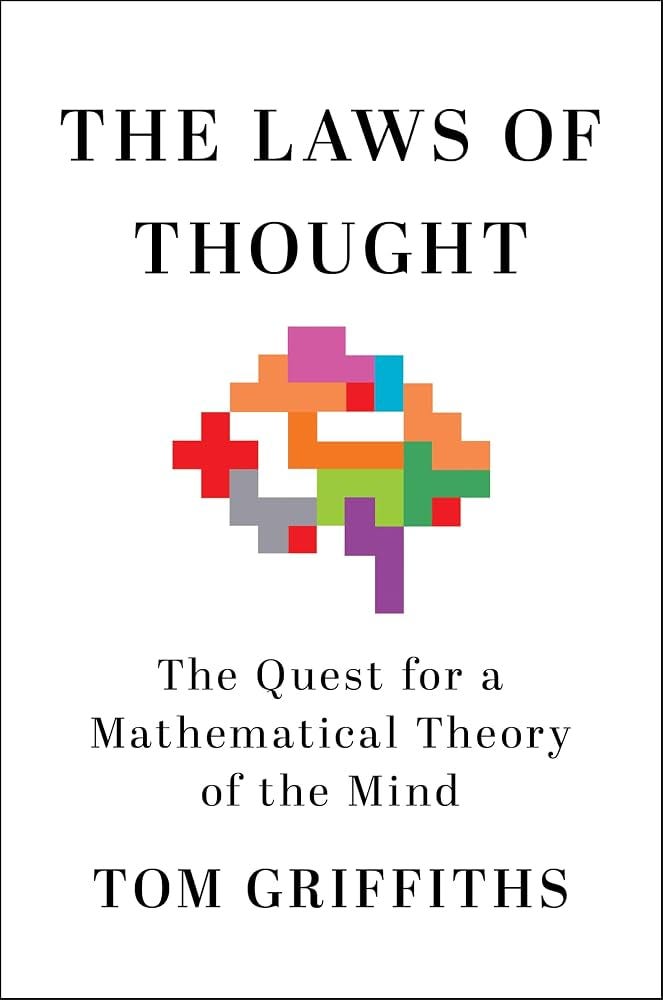
Standing resolutely against that tide, Tom Griffiths’ recent book The Laws of Thought: The Quest for a Mathematical Theory of the Mind shines a spotlight on parts of cognitive science that rarely make it past university walls. Daring to write a public-facing psychology book that sheds empathetic anecdotes in favor of mathematical explanations, Griffiths maintains a clear and approachable tone as he guides readers through the exciting developments in how his field understands thought. Griffiths breaks down the study of thought into three roughly chronological portions: the search for a formal language of thought, the development of neural networks, and the modern use of Bayesian modeling.
Griffiths describes how, for many years, the study of thought was shaped primarily by philosophy and linguistics. Theorists searched for formal deductive symbolic systems that could explain the Language of Thought. As he builds on this narrative, explaining its applications in early “thinking machines,” Griffiths begins to show his readers the limitations of a formal symbolic approach: it is incapable of addressing interpolation or inductive reasoning, aspects of cognition that constantly drive human thought.
As he tells the story of how neural networks were developed, he provides an understandable yet rigorous explanation of why neural networks can explain interpolation in a way symbolic systems never could. But neural networks have limitations of their own. Griffiths describes their foreign and data-hungry ways, particularly emphasizing how they fall short of explaining realistic human induction or intuition.
At long last, Griffiths turns to the crown jewel of methods: Bayesian modeling. He explains to his readers why Bayesian models of behavior, when applied thoughtfully, manage to explain human behaviors completely inaccessible to formal logic or neural network models. This final section on Bayesian modeling is, in my opinion, what makes this book excellent.
To be clear, the prior chapters are great overviews of the science. Griffiths adeptly covers everything from relevant philosophical paradoxes to the structure of perceptrons with a clarity that would be respectable for a specialist in any one of these fields, much less an author who understands them all. But I have to say I was pleasantly surprised to find a book that addresses Bayesian modeling so thoughtfully.
If you’re the kind of person who’s used to seeing “Bayesian” and “psychology” in the same sentence, you’re probably (no pun intended) thinking of how bad people are at dealing with Bayesian statistics. There are many interesting and thought-provoking studies on our fallacious intuitions about probability, or our quick-and-dirty “System 1” that leaves rationality in the dust and forms biases out of manhandled math. It’s easy to come away from these results thinking that, if anything, human thought is not Bayesian enough.
The Laws of Thought manages to place that exciting literature in its proper context. Griffiths explains how Bayesian models are not at odds with these results, showing that, in fact, appropriate understanding of Bayesian models actually explains these phenomena. Moreover, Griffiths dives deeply into the theoretical underpinnings. He shows how Bayesian models finally uncover a coherent picture of inductive reasoning and concept-learning in a manner that neither neural networks nor symbolic systematization could ever achieve.
When I first saw The Laws of Thought, my first instinct was to celebrate that someone was finally focusing on the computational side of neuroscience and psychology. I’m a grad student studying computational neuroscience myself, and I’ve long lamented that despite how crucial computational modeling is for research into cognition, it is seldom mentioned in the popular narrative of neuroscience, much less explained thoroughly.
Griffiths did justice to computational models of psychological phenomena. But, I have to admit, I spent most of the book waiting for the “neuroscience” part to come in. Despite explicitly referencing the field of “computational neuroscience” numerous times, and constantly mentioning the brain, Griffiths essentially ignores any work which directly studies that organ. He briefly trots out two of the biggest hits of early neuroscience from the mid-20th century—Hebbian learning and Hubel & Wiesel’s famous discovery of neurons “tuned” to particular visual features—but Griffiths treats these discoveries as mere background for the development of neural networks, rather than contributions to cognitive science in their own right.
The Laws of Thought has a massive neuroscience-shaped hole. This struck me most when Griffiths turned to one of his favorite analogies for the role of a cognitive scientist: Griffiths asks you to imagine that mysterious government agents bring you to a strange archaeological site. There, they have found a strange object for you to study which they believe to be “some kind of information-processing device” that deals with electrical “inputs” and “outputs.” The agents tell you that your task is to “figure out how this object works” without damaging it.
Of course, Griffiths discusses answers that perfectly skirt around the field of neuroscience; he essentially guaranteed as much. The thought experiment would be much less clean if Griffiths also added, “Oh, and the object is actually made up of parts you can study in a dish! Plus, there are billions of similar objects that this one evolved from, and you are allowed to peek inside those.”
I’m not complaining about the omission of neuroscience because I want to see my field highlighted at the cost of others. On the contrary, I can’t help but feel that it’s the missing piece that would have made The Laws of Thought all the more compelling. When Griffiths explained discoveries about structured vector spaces of information represented by neural networks, he could have pointed to discoveries showing that similar structures arise from real neurons in real brains. When Griffiths explored the role of gathering evidence in decision-making, he could have included just how much real neural signals match his points. When Griffiths discussed the complexities of categorization and the paradox of vagueness that stands in the way of clear category boundaries, he could have turned to the counterintuitive neuroscience which shows how neurons warp the fuzzy, gradient-like boundaries in the real world into strict dividing lines in the brain.
I don’t believe Griffiths should have included neuroscience to glorify it. Rather, I believe that including more neuroscience would have glorified Griffiths’ own ideas. My experience of The Laws of Thought was deeply enhanced by my own background because I knew just how much Griffiths’ narrative and perspective is backed up by our knowledge of real brains. I only wish all readers could have that same opportunity.
Nonetheless, The Laws of Thought explores the study of the mind and brain as it’s rarely seen in popular culture. I may be biased, but the fact that we can truly think seems like the most incredible mystery of our time. Billions of cells folded into our skulls create everything that we experience—everything we think or say or decide—and Griffiths manages to distill exciting scientific discoveries about that process into a neat narrative. How could you not want to read that?