


“We should not be haunted by the specter of being automated out of work, We should be excited by that. But the reason we’re not excited by it is because we live in a society where if you don’t have a job, you are left to die. And that is, at its core, our problem.”
– Alexandria Ocasio Cortez, 2019
Automation is on the way
Last year, Amazon’s one-millionth robot was deployed under the direction of DeepFleet–an automated system that coordinates robot swarms to run unmanned fulfillment factories. The length of software-engineering tasks LLMs like ChatGPT can complete has been doubling year-over-year; we are now at 4 hours. Will AI take your job? Probably not yet, but entry-level employment is already declining in AI-exposed industries. In Q3, without any increase in hiring in the US economy, GDP just increased by an annualized rate of 4%.
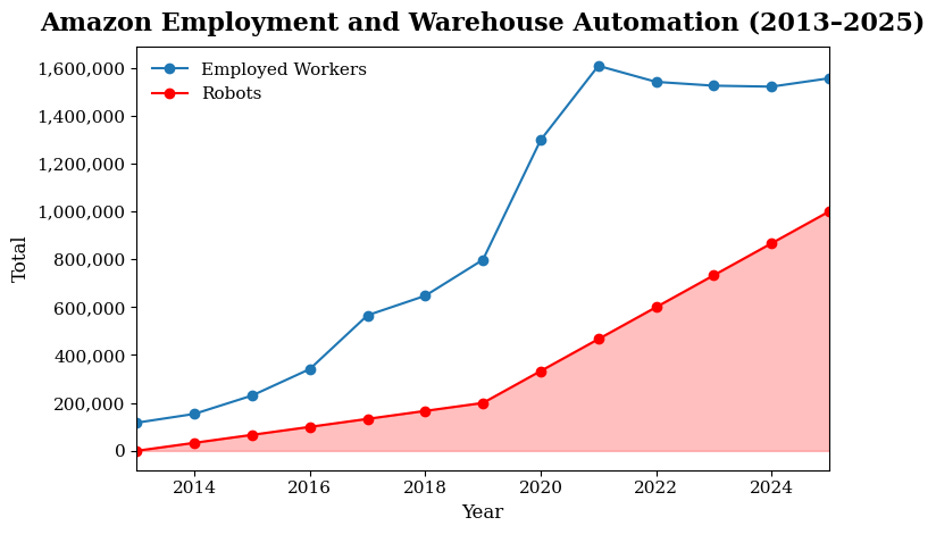
Sources: Employment from Amazon SEC filings. Robot deployment from Amazon disclosures (2019, 2025); intermediate years linearly interpolated.
It has become commonplace for leftists to express skepticism regarding the capabilities of LLMs; a general belief in technological “enshittification” in which scientific development has been hijacked by financial capital to capture attention and generate hype for speculative assets. This view is basically true in the context of cryptocurrency and social media. However, given evidence of improving capabilities of AI and robotics alongside increasing deployment, we must address the possibility of mass automation. Those skeptical of human-level artificial general intelligence often balk at this premise, but even sub-human models that can complete domain-specific tasks like driving or coding may cause layoffs sooner than later. In other words, you don’t need fully general intelligence to achieve general automation. Debating whether AI can automate many jobs or all jobs is meaningful, but in either case it becomes clearer by the year that large parts of the economy can and will be automated.
Socialists must have a plan to direct an automated economy towards the benefit of all people. How could the threat of AI make clear the shared interests of working people and build a durable political coalition? How can minimize the risk this technology poses to humans and the environment? What policies are sufficient to prevent an inegalitarian concentration of power?
If the left lacks a plan, the right will implement theirs.
Who will control this technology?
“Artificial intelligence (AI) and robotics are going to have a profound and transformative impact on our country and the entire world. The question is not whether these technologies will advance. They will. The question is: Who will control this technology? Who will benefit from it? And who will be left behind?”
– Bernie Sanders, 2025

The Trump administration along with the barons of technology and finance are engaged in an open conspiracy to keep the benefits of automation to themselves. Venture capitalists like Marc Andressen are funneling their capital into military contractors and political action committees to target politicians who threaten AI development. In return, President Trump has issued an executive order to entirely pre-empt all state AI regulation. A federal pre-emption on regulation hasn’t happened for oil, for tobacco, for any normal technology. While the working class might use automation to escape work, the oligarchs want automation to escape the worker.
Neoliberal visions of an automated economy allow for an unacceptable concentration of power and have no real understanding of political conflict. In this trajectory, those with equity in frontier AI companies will live like planetary aristocrats while some measly portion of future profits is doled out as UBI to a permanent underclass. The first mistake is ignoring that inequality is undesirable in-and-of itself. The second mistake is assuming the politicians and techno-capitalists who control AI will act benevolently towards society solely because improving the welfare of others would come at little cost. In fact, the history of powerful people doing evil-at-cost is quite rich! The solution to the concentration of wealth and power AI portends is exactly what socialist politics has always demanded: the reorganization of the economy directed from the bottom-up.
Luckily, the leftist position on a post-scarcity future is already popular. Those who sincerely believe in artificial general intelligence have independently come to the conclusion that a mass redistribution of wealth might be necessary. If you poll the American public who should own AI in a world where AI replaces human labor, 44% agree every citizen should own an equal share (27% are unsure). This is, conditional on mass automation, near-majority support for full-on communism. Pessimism about AI lines the rust belt; working class voters who have swung towards the right still understand what it’s like to see their entire town be laid-off. Tech workers are starting to know the same feeling. There is an open niche for an AI-forward economic populist politics to unite the working class from California to Pennsylvania.
Unfortunately, establishment Democrats lack the backbone to stand up to the tech oligarchs. As a paradigmatic example, Governor of California and 2028 frontrunner Gavin Newsom has vetoed bills that would have regulated how chatbots interact with children, how employers use AI for hiring and workplace decisions, and mandated safety audits for frontier models. Even the RAISE Act—a bill introduced by a relative moderate, Alex Bores, that requires basic transparency and risk-mitigation from frontier AI companies without threatening profit or ownership in the slightest—had its main mechanism of enforcement cut by New York Governor Kathy Hochul with minimal public backlash. Corporate Democrats are too dependent on large donations to fight back against the AI PACs. Without pressure from the organized left, these politicians will continue to roll over for big tech.
The right is in bed with oligarchy. The center lacks the means to combat corporate money. Then it is the left–and only the left–that can offer a positive future in response to automation.
Towards the Abolition of Poverty and Labor
Proposals beginning to address the automation have come from erstwhile progressives and technocrats: a wealth tax, worker-appointees to AI company boards, regulated development of foundation models. It is shocking that these ostensibly socialist policies aren’t coming from socialist politicians.
While leftist critiques of AI exist, most approach the issue from frameworks that do not recognize transformative automation as a real and desirable possibility.
For example, data center construction is often critiqued on the basis that either:
(1) Data centers are merely speculative assets
(2) The production of data centers is inadmissible due to climate effects
In specific, data centers hit capacity as soon as they go online, water demand is only a problem in places already undergoing drought, and carbon emissions from data centers could be minimized by expanding the grid. We can envision solutions for these problems that do not demand a moratorium on data center construction: AI companies pay for clean expansions to the public grid, build where there’s enough water for cooling, etc.
But truthfully, these critiques are symptoms of a broader worldview that precludes the possibility of a post-scarcity society:
(1) Improvements in AI–and most technology–is not real
(2) Economic growth is fundamentally at-odds with climate change
I disagree. Socialism must aspire towards the abolition of both poverty and—ultimately—labor. Poverty deprives people of the bare necessities, and the coercion of labor deprives people of their autonomy. To achieve this, socialism must produce equitably distributed clean economic growth, which is only possible through technological advancement. It is the moral obligation of socialist politics to achieve this future.
In the same breath that we reject tech oligarchy, we reject the scarcity of the present. We must not be caught on our backfoot. The left has long dared to envision a world without poverty and work; now we fight for that world at its cusp.

I agree with a lot of what was said here. But the left needs to meaningfully confront the ideology behind the quest for AGI. TESCREAL has lots of eugenicist roots and the left needs to figure out what its outlook on the future of humanity and our species is.
Fantastic work!