


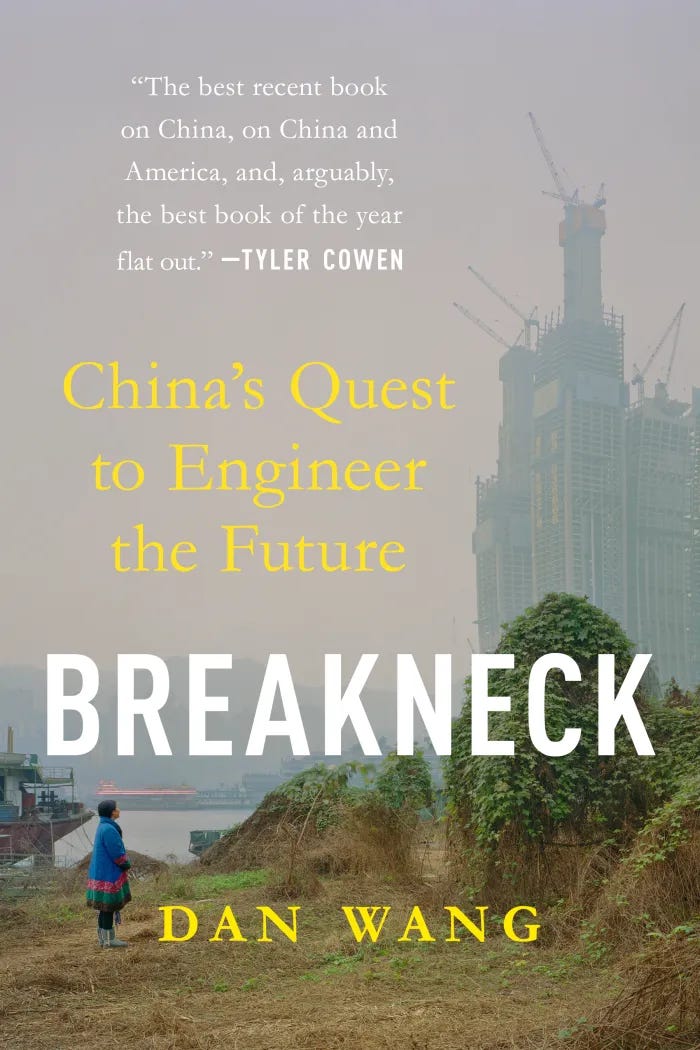
If you have been anywhere on Substack in the last year, you have likely encountered, either in form or in substance, Dan Wang’s tell-all on China, Breakneck. Wang has made the rounds across the online world, speaking with a long parade of China experts, abundance capitalists, economists, and academics about his novel framework for viewing the world’s two largest economies: China is an engineering state administered by engineers, whereas the United States is a lawyerly society run by lawyers. Better to understand China and the United States through these labels than through the imperfect ascriptions of socialist and capitalist, Wang argues. China has modernized and built at warp speed because it is an engineering state, while the United States has slid into the morass because statutes and suits block much-needed manufacturing and infrastructure development.
Breakneck’s lofty objective is to demystify Chinese intentions and political character for Western generalist audiences. Wang largely succeeds, painting his picture of China, the engineering state, with smooth prose and anecdotes that evince China’s obsession with engineering technology and society. Wang is quippy and quotable, and his writing shines in the chapters where he focuses his sights exclusively on telling China’s story.
Above all, the guiding motive for Breakneck is Wang’s belief that the United States and China are more alike than dissimilar, and should therefore learn from one another. The author says that China’s overemphasis on engineering and its shortage of lawyers have produced atrocities like the one-child policy—a project that would never have survived the sharp tongue of American pluralism and the lawyers who defend it. And for the United States, the lesson is to just build more, like China has done. Speaking with Tyler Cowen in December, Wang prescribed that the United States be 20% more “engineering-minded” and China 50% more lawyerly. This framework, and the policy it implies, sounds sensible, picking at the weaknesses of both societies.
However, Wang’s engineer-versus-lawyer framework feels so right and so straightforward that analysts have largely failed to examine it with the requisite rigor. I’ve yet to come across a review that grapples with the idea of the engineering state and its appropriateness for describing China.
When further examined, Wang’s framework proves to be not a helpful heuristic for explaining China’s behavior and intent, but a flattering abstraction—one that obscures the revolutionary history and dialectical authoritarianism actually driving Chinese development, and that tells us less about China than the word it was meant to replace.
The difference between an and the
Wang presents two definitions of engineering statehood, divided based upon the modifying article. Wang uses “an engineering state” to describe something general—the nation that China is, the United States was, and any country can be. “The engineering state” is a concept that can only describe the People’s Republic of China. This characterization is deeply personal, taking on the flaws and quirks the modern Party government exhibits. Wang does not clarify this distinction, and places the burden on the reader to navigate the similarities and dissimilarities between the indefinite and definite engineering states.
The features of an engineering state can get confused with those of the engineering state. An engineering state can be a state that is administered by engineers. This is a notable feature of the modern Chinese Party government, with leaders from Jiang Zemin to Xi Jinping holding bachelor’s degrees in various engineering fields. However, Wang admits in an interview that the engineering training many of these leaders received was “perfunctory at best”, recognizing the gap in knowledge between engineers by accreditation and engineers by vocation. He grants exceptions—Hu Jintao, he notes, actually helped build a dam—but the exceptions prove the rule. Thus, an engineering state is not simply defined by its leaders’ college degrees; an engineering state must also be adept at completing engineering projects. Wang uses the term in this way when describing President Dwight Eisenhower’s America as an engineering state, given its success in constructing the interstate highway system. Qualifying engineering projects also include physical works like factories, dams, and bridges. Social engineering programs count too—Wang almost implies they are comorbid with periods of intense physical development. Subjugation of minority populations in the name of industrial progress featured in both the U.S. and Chinese pushes toward modernity. How these projects fit into Wang’s moralization of anengineering state as either good or bad is unclear.
The concept of engineering statehood becomes looser when Wang uses it as a stand-in for the People’s Republic of China. Wang describes the engineering state as a jealous god, a fickle, vain, and fundamentally imperfect behemoth that takes itself and the world too seriously. Wang peppers Breakneck with sentences such as “[the engineering state] likes to build not just public works but also manufacturing capacity. The engineering state resists economists as easily as lawyers”, and “the engineering state is intent on achieving tech primacy before multinationals pull away”. Such descriptions are specific to the personality of the Chinese Party-state rather than engineering states more broadly.
The characterization becomes more confusing when Wang relates China as the engineering state to the general idea of an engineering state. Wang implies that an engineering state will have an immutable respect for engineers, derived from his analysis of the engineering state’s imperial projects such as the Great Wall and Grand Canal. Does this not then implicate Egypt and Rome as contenders for engineering statehood, as the inheritors of the Great Pyramids and the aqueducts? Or is this an instance of Wang’s conception of the engineering state bleeding into his characterization of anengineering state? This confusion prompts questions about the connection between China’s individual case and the broader Platonic ideal of an engineering state—if such a state actually exists. China seems not to be a member of a group of engineering-minded peers, but a particular standing aloof in the empty fields of the general.
Let’s talk about Mao
While there might be many manifestations that an engineering state could take, Wang makes clear what it is not. We can be sure that it is not the modern United States, governed by lawyers and the rule of law. It was also not Mao Zedong’s China; per Wang, China became the engineering state only under Deng Xiaoping.
Wang’s initial characterization of the Chinese engineering state sets it inherently apart from Maoist China: “As a corrective to the mayhem of the Mao years, Deng Xiaoping promoted engineers to the top ranks of China’s government throughout the 1980s and 1990s.” Wang continues to distinguish between Mao and his successors—Deng, Jiang, Hu Jintao, and Xi: “Mao was not an engineer”, Wang says. The statement is entirely correct. Mao was certainly not an engineer, and his lack of credentials is perhaps what allowed the Great Helmsman to undertake such naive and murderous projects as those of the Great Leap Forward. But lack of education isn’t enough to exclude Mao, because Deng was not an engineer either. Deng never graduated from college. He spent his early twenties in France as a worker-student, closer to a factory floor than to a laboratory, before studying Marxist theory at Moscow’s Sun Yat-sen University, a Soviet institution founded to train Chinese revolutionaries.
Wang rightly assesses that the two leaders treated engineers quite differently during their reigns; Deng gave them plaudits, while Mao, punishment. Mao prioritized “red over expert”, or political loyalty over trained expertise, and expelled scholars who attempted to speak out against the Party after the brief period of state-sanctioned free speech known as the Hundred Flowers Campaign (1956–1957). The crackdown on scholars, labeled the Anti-Rightist Campaign (1957–1959), was the responsibility of the Party’s sixth-ranked leader at the time, none other than Deng Xiaoping, who supervised the subjugation of some 550,000 so-called “ideological enemies” by the Party’s own count, and by some assessments well over a million. Deng managed this campaign brutally, and his overzealous enforcement is reported to have had a deleterious impact on China’s scientific and economic establishments (see Jonathan Spence’s Mao Zedong: A Life). Breakneck fails to mention this.
So, on what grounds, then, can we treat Mao as an aberration from the engineering tendencies of China’s past and future and ignore the Chairman’s obsession with modernization? It was Mao who pushed for projects to broadly expand manufacturing, and Mao who kept the Three Gorges Dam alive as a project of state. He proposed damming the gorges in 1953 after touring the Yangtze; he stood up the Yangtze Valley Planning Office in 1956 to run the surveys and the designs; and in 1958 he put the question to the Central Committee directly, weighing Lin Yishan’s case for the dam against Li Rui’s case against it, and coming away with an instruction to finish the preparatory work. The survey and design work of the Mao years supplied the foundation for the construction that finally began under Jiang in 1994.
I have just drunk the waters of Changsha
And come to eat the fish of Wuchang.
Now I am swimming across the great Yangtze,
Looking afar to the open sky of Chu.
Let the wind blow and waves beat,
Better far than idly strolling in a courtyard.
Today I am at ease.
“It was by a stream that the Master said—
‘Thus do things flow away!’“
Sails move with the wind.
Tortoise and Snake are still.
Great plans are afoot:
A bridge will fly to span the north and south,
Turning a deep chasm into a thoroughfare;
Walls of stone will stand upstream to the west
To hold back Wushan’s clouds and rain
Till a smooth lake rises in the narrow gorges.
The mountain goddess if she is still there
Will marvel at a world so changed.
—Mao Zedong, “Swimming”, 1956
Mao was not an engineer, but he believed in the poetic power of grand works. And in pursuit of that power, Mao razed the walls of Beijing, turning a city once composed of wandering alleyways and corralled by imperial ramparts into a canvas for Soviet-style urban planning, grand squares, and gridded avenues at the time useful mostly to donkeys and rickshaws. Liang Sicheng, the most eminent architect in the country, argued for sparing the walls and building the new administrative capital to the west; he was overruled. A coherent definition of China as the engineering state would recognize that modern Chinese impulses are also reflected in the Mao era. While more philosophical than successful, Mao’s China was the first to exhibit the neuroses and modernization ambitions that Wang uses to describe theengineering state of today.
Mao’s penchant for large-scale infrastructure arose not from China’s historic proclivity toward engineering but from the technological backwardness of the cloistered Qing dynasty (1644–1912). The Chairman’s developmental craze, manufacturing push, and harebrained five-year plans derived first and foremost from the ideas of Chinese scholars and officials evaluating the country’s failures under the Late Qing (1840–1912). Reformers attributed China’s decline at the hands of colonial powers to its failure to modernize; were China historically an engineering state that valued technological progress and technocrats over Confucian precepts and formalism, those reformers would have had nothing to criticize. They pressed for the adoption of Western technologies and scientific practices under the formula that the Qing official Zhang Zhidong made famous, “Chinese learning for substance, Western learning for function”(中学为体,西学为用). That current of reform, and the more radical politics it proved unable to contain, brought about the end of the Qing dynasty, the decapitation of China’s imperial system, and the eventual birth of a “New” China governed by the Communist Party.
This Communist Party, nurtured by Chinese reformers, weaned on Soviet philosophy, and matured with American technology, has modernized the country to ensure both the Party’s and the state’s survival, legitimacy, and strength. It has maintained a balanced contradiction between East and West in both its governance and its approach to development. Of notable similarity to the mantra of revolutionaries past is the modern effort to blend Western modalities with Chinese reality, “socialism with Chinese characteristics” (中国特色社会主义). In this process, the Party deploys engineers and scientists with purpose and discards them when needed, and regardless keeps them on a leash whose tightness fluctuates according to the judgment of China’s top cadres. The contradiction in the Party’s approach, where it can simultaneously launch crackdowns on leading entrepreneurs while promoting free-market style investments, and embrace scientists as the country’s future while suppressing doctors sounding the alarm at disease outbreaks, is baked into the character of “New” China. It is also what makes describing Chinese behavior with a comprehensible, simple label so challenging.
Praise for the amputee
Trying to analyze China through the lens of engineering statehood is therefore a misguided enterprise. Given the amorphous definition of both levels of engineering statehood, Wang’s selective application of the label, and the moniker’s flattening of the complicated, contradictory relationship between the Party and scientific development, it is clear that thinking of China as the engineering state is both vague and reductive. The label is functionally more opaque and obscurantist than calling China “socialist,” for that at least begins to tug at some of the deeper ideological backgrounding for China’s modern development.
Most Western partisans who use this engineering state framework have muted the relevance of China’s revolutionary history and the Party’s dialectic authoritarianism, ignoring how these features have underpinned China’s modern engineering accomplishments. Commentators whose agendas suit them to it can hold up the People’s Republic as a utopia for technological development, praising the nation as a standard to which the United States should aspire, a noble technocratic regime keen to pursue the wellbeing of its people, encapsulated in its divine achievements of high-speed rail, high-density housing, and high-output manufacturing.
Beyond the importance of building, it is unclear what Wang and likeminded commentators want to promote. The United States, they argue, should be more of an engineering state—by a degree of 20%, per Wang’s assessment—and learn from China as the engineering state. Put concretely, the United States should modernize its infrastructure and prudently reshore manufacturing capabilities in sectors critical for economic growth, citizen welfare, and national security. In doing so, the country would do better for itself and its people. However, the path forward is not one best learned through studying China. The engineering state does not provide a replicable model for a state looking to recenter development and manufacturing. A vague and unfounded idolization of China as a paragon of engineering only benefits China’s program to manufacture pro-Party sentiment among Western populations through half-truths, propaganda, and algorithms. Such an effort is not new. When China reopened to foreign visitors in the early 1970s, with the Cultural Revolution still grinding on, it wooed the West with similar tactics, walking new influxes of foreigners through factories, communes, and restored temples to see the benefits that Maoism had supposedly brought. The modern revival of popular pro-China narratives among Western tech-focused commentators suggests the continuity of a phenomenon that the esteemed sinologist Simon Leys critiqued fifty years ago in Chinese Shadows, published in French in 1974 and in English in 1977:
“Western ideologues now use Maoist China… as a myth, an abstract ideal projection, a utopia which allows them to denounce everything that is bad in the West without taking the trouble to think for themselves. We stifle in the miasma of industrial civilization, our cities rot, our roads are blocked by the insane proliferation of cars, et cetera. So they hurry to celebrate the People’s Republic, where pollution, delinquency, and traffic problems are nonexistent. One might as well praise an amputee because his feet aren’t dirty.”

Excellent
Wang seems oblivious to an endless world of inventions and creations, such as Apple and the iPhone, Uber, Nvidia, Intel, McDonalds, human rights, the rule of law, democracy, subcontracting labor intensive manufacturing to China!, and more recently such things as the Covid vaccine and ChatGPT. Who is the engineering state?