


The Left Should Trust the Science
The political left has historically had a strong and beneficial relationship with scientific consensus. We see climate change deniers as shills for selfish oil corporations. We see anti-vaccine influencers as reactionaries hawking unregulated supplements. Why do we fail to see the AI Denial Industry for the pseudoscientific grifters that they are?
The AI Denial Industry consists of a set of magazines, corporate entities, and influencers who sell AI skepticism as the product. The demand for this content emerged out of genuine concerns regarding surveillance and algorithmic discrimination. These concerns characterized progressive discussion of technology in the 2010s in magazines like Wired, but the audience for this content really hit critical mass as part of a general reaction against AI art and industry hype around the release of ChatGPT. Since then, the claim that AI is useless, stagnant, or irrelevant has been repeated to the point of serious consideration on the left.
(To be clear, I do not extend this critique to all anti-AI positions; arguments regarding AI effects of economy/climate or how to safely develop AI are live topics of scientific debate.)
This minoritarian scientific position has been maintained with pseudoscientific reasoning to sell commodities, and it prevents socialists from addressing substantive issues of capable AI. If the Left is going to propose socialist AI policy, we need to trust the science.
AI Denial is Against Scientific Consensus
While running a boutique PR company for smaller AI companies, Tech critic Ed Zitron is one of the most vocal profiteers of AI Denial. Featured everywhere from Forbes to Wired to Chapo Trap House, he has gained notoriety spreading an acerbic case for the certainty of an AI bubble. Mixed in with solid coverage of capex expenditures and a particularly strong case on the financial vulnerability of CoreWeave, Zitron pushes the idea that LLM capabilities are essentially a long con:
“When you put aside the hype and anecdotes, generative AI has languished in the same place, even in my kindest estimations, for several months, though it’s really been years. …these models, even when grinding their gears as hard as humanely possible, are exceedingly mediocre, deeply untrustworthy, and ultimately useless.”
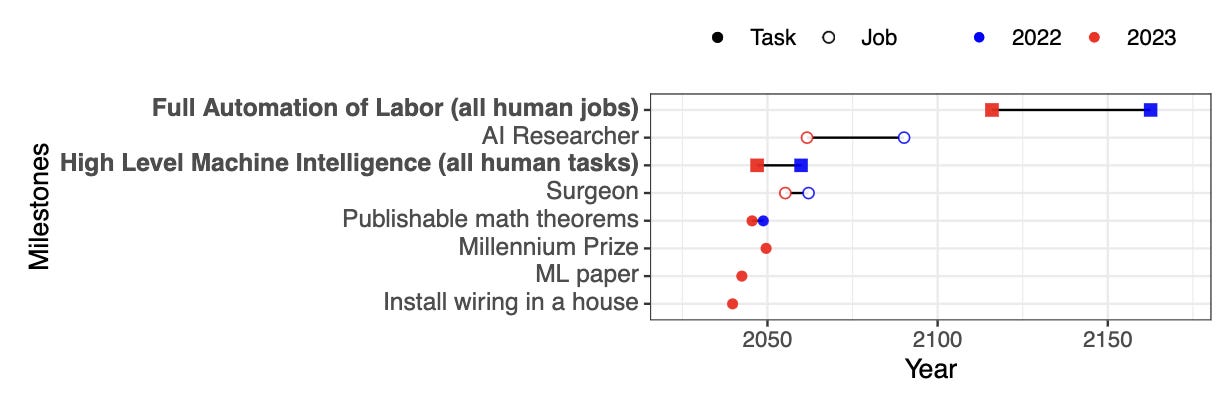
Actual scientists disagree. In a survey of almost three-thousand published AI researchers in 2023, forecasts of future AI capabilities showed an extreme speed-up in expectations compared to 2022. On aggregate, in 2022, the ability for AI to succeed at all human tasks was given a 50% chance to occur by 2060; one year later, scientists accelerated their prediction timeline to 2047. Likewise, In one year of development, the prediction timeline for full labor automation became 47 years faster.
What has happened in the years since then? Notice above how the automated production of a publishable math theorem was given a 50% chance to occur by 2040. According to the most respected mathematician in the world, Terrence Tao, this has already happened: a large language model solved Erdos problem #728 “more or less autonomously”.
After the release of ChatGPT, computer scientists designed a variety of difficult benchmarks to quantify AI capabilities across various task modalities from reading comprehension, competition mathematics, and multimodal reasoning. Since then, according to Stanford’s 2025 report, frontier models now score similarly to humans across each of these domains. Every benchmark we create to measure model capability becomes saturated in a matter of months. This is unprecedented.
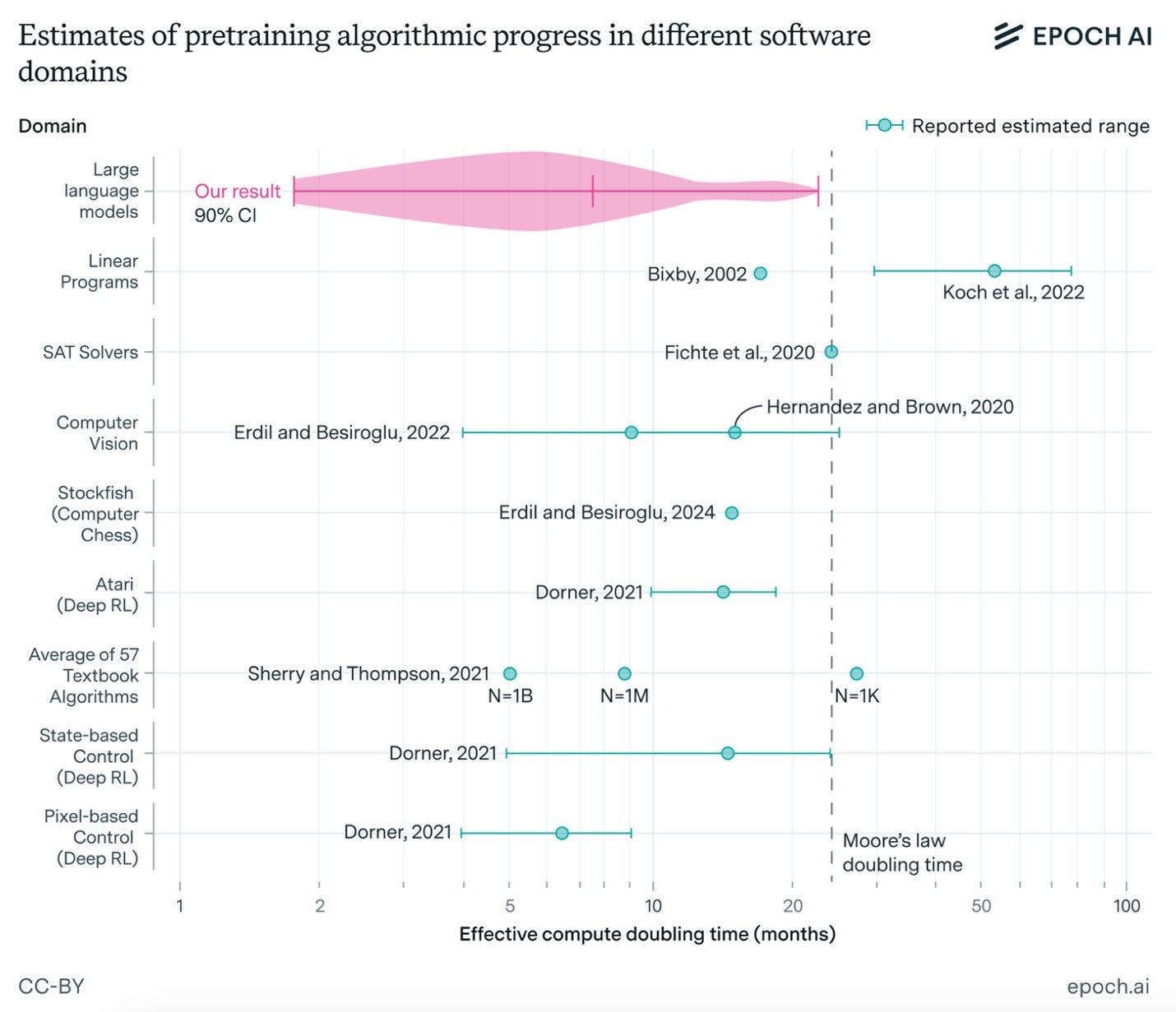
Not only are models becoming increasingly capable, but they are also becoming more efficient. A third party research organization, Epoch AI, has determined that algorithmic process in LLM pre-training is increasing faster than would be expected from growing compute alone.
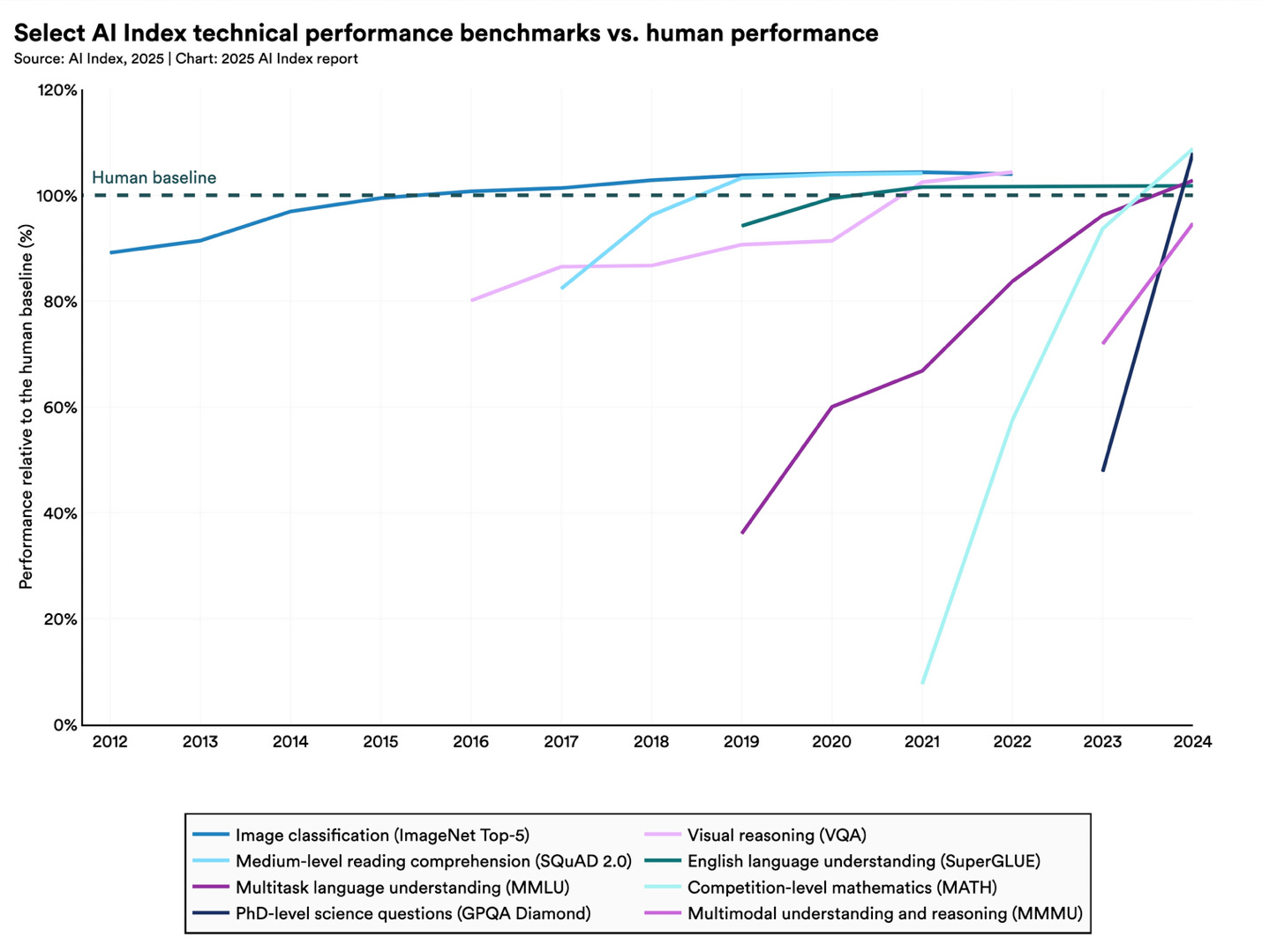
Absent any extrapolation to a future explosion in AI capabilities, it is scientific consensus among academic and non-profit AI researchers that over the past four years LLMs have improved dramatically in most ways we know how to measure. To deny this conclusion against such a preponderance of evidence is equivalent to concluding that vaccines cause autism or that climate change is a hoax; extreme scientific heterodoxy. So, how and why do Denialists defend such a position?
AI Denial is Pseudoscience
The economy of AI denial is greatly analogous to that of the supplement industry:
A scientist publishes some research that makes limited, empirically backed claims
That finding is spun, either by a magazine or by the scientist themselves, as more heterodox than the actual evidence suggests
Influencers repeat the spin on short-form media platforms to grow their brand, weaving these claims into larger political or cultural issues to gain engagement
Given an amplified platform, a few scientists put a hold research altogether to do the media circuit, getting paid to write books, give talks, and go on podcasts, often starting a non-profit
The industry grows selling skepticism as the product
An illustrative example: Two weeks ago Wired released “The Math on AI Agents Doesn’t Add Up,” which argues that a new paper has proven that AI agents are “doomed to fail” right up until the paywall, then admitting that’s not what the paper says at all. This is how the pop-science industry profits off all types of pseudoscientific views. I doubt most leftists understand that AI denial is against consensus; they’ve just seen the vibes sold by left-facing media and inferred the rest.
However, there’s a type of deep pseudoscientist that doesn’t accept evidence. When you really press a dedicated anti-vax grifter on how vaccines don’t cause autism, they start asking whether we really “know” what “causes” anything? Unfortunately, AI has those too.
AI Denial Plays Language Games
` In 2015, Republican Senator James Inhofe threw a snowball onto the Senate floor to demonstrate how global warming must be a hoax. Of course, we understand this is ridiculous. When climate scientists say “global warming” they really mean something like “climate change”, which is a complex phenomenon that is by its essence difficult to define. Senator Inhofe focuses on a tiny semantic feature, “warming,” to dodge the complex scientific argument entirely. Any leftist immediately understands that this is a nonsense argument.
Is artificial intelligence actually “intelligent”? This is a meaningless question. When AI researchers use the term “intelligence,” they are usually referring to a behaviorist definition of observable capabilities. If a model can solve mathematical problems, then it has mathematical intelligence. That’s it. It is not taken for granted that intelligence in one field transfers to every other field, nor do researchers assume that AI is particularly human-like. Still, many deliberately obfuscate how to respond to rapid AI improvement by transposing the argument into the semantics of whether models can truly be “intelligent.”
The well-cited 2021 paper, “On the Dangers of Stochastic Parrots: Can Language Models Be Too Big?,” was primarily concerned with the dangers of scaling compute in response to GPT-2: reasonable concerns about equity, safety, and the environment. The authors’ rejection of computationally large models hinged on one load-bearing argument: that language models are purely probabilistic models of words with no reference to meaning. Therefore, they hypothesize, scaling language models will fail to produce models with representations of the world that are more structured than statistical correlations. This is a well-defined, empirically testable claim that has since been proven false. From innovations in Reinforcement Learning and Reasoning architecture, LLMs gained capabilities in domains that rely on underlying structure that is not found in the mere correlation of words: mathematics, physics, and biology.
Instead of accepting the evidence and considering how to safely and equitable govern generally capable AI systems, some authors of this paper have spent the past five years playing word games with the term “intelligence”. As of 2024, first author Emily Bender publicly said, “We have to keep in mind that when [LLM] output is correct, that is just by chance,… You might as well be asking a Magic 8 ball, right?” To argue that AI is not a serious technological development because it only passes every benchmark, design novel proteins, and code an entire compiler by chance without real understanding is a distinction without a difference. The second author, Timnit Gebru, has since argued at length that, since quantifying “general intelligence” has its roots in eugenics and IQ metrics, then trying to make systems that have “general intelligence” is eugenics. Therefore, we should only build specific AI systems, like the ones her non-profit makes. This argument was co-authored with Emile P. Torres, who of course has their own podcast, and has gone on to write “If Artificial Superintelligence Were to Cause Our Extinction, Would That Be So Bad?” in which they say awesome things like:
“Environmental considerations yield a third reason for pro-extinctionism: our systematic obliteration of the biosphere is not only imperiling our own future on Earth, but causing untold harm to billions of nonhuman organisms, ecosystems, and landscapes. If one accepts a biocentric, biospherical egalitarian, or ecocentric theory of value, then Homo sapiens is not the only thing with intrinsic or final value. For the sake of these other things, it would be best if “Homo shiticus” — as some environmentalists call us — were to no longer exist.”
AI Denial Distracts from AI Safety
AI Denialists are not brave whistleblowers against the AI hype machine. They are more like MAHA grifters selling supplements—denying the science to profit off of your attention and enrich themselves.
The scientific consensus is not only that AI will rapidly improve, but also that forward-looking policy is necessary to mitigate the social harms of AI. In the aforementioned survey, AI researchers do not universally agree that improved AI will lead to a net positive outcome. The majority believe that AI safety research and democratic protections must be prioritized more than they are today.
As in biomedicine, there are real trade-offs that must be made between the dangers and benefits of AI. The supplement industry is the result of real failures of the American biomedical complex. The socialist response is not to just naively agree with pseudoscience against big pharma, but to demand a fundamentally egalitarian restructuring of who benefits from technological development.
The reason AI denial has found such a receptive audience on the left is that the tech industry has earned every ounce of distrust directed at it. When the same people who sold the benefits of social media, crypto, and gig work now tell you AI is the future, suspicion is warranted. The problem isn’t that the Left is too skeptical of Silicon Valley. It is that justified skepticism of the industry has been allowed to harden into a blanket dismissal of the technology itself, and this cedes the conversation to the right. The grift isn’t suspicion of the industry; the grift is suspicion of the technology. Taking AI seriously is exactly how we take the reins from the tech oligarchs into the hands of the people.
Once we align ourselves with the scientific consensus, there are plenty of immediate problems for us to address. While some demand a full-on moratorium on datacenters, a state-by-state regulatory campaign is most likely to concentrate data centers in red states (or worse alternatives like the UAE, or for Elon Musk: space) where we lose the ability to regulate AI development while carbon ends up in the atmosphere anyway. The demand in energy to fuel new datacenters requires us to double down on the expansion of public clean energy as an alternative to behind-the-meter gas-powered compute. There are technical ways that AI bias or mental health effects can be addressed, and public funding of AI safety research can ensure that this research gets done. Given how fast this technology has developed, it is reasonable to call for more precautionary regulation like the RAISE Act. Rapid concentration of power into techno-capital may even necessitate a transition to public ownership, and socialists should have a framework in place for this.
It is unlike the left to abandon scientific truth. We know that we need to reduce carbon emissions. We know that vaccines are an important tool to maintain public health. We know that gender affirming care is associated with long-term positive psychological outcomes for transgender patients. It may be inconvenient for AI to be improving as rapidly as it is, but it would be disastrous to pretend like it isn’t happening at all.


There actually is a science to follow on this, but given the left's skepticism against AI hype, it's doubtful we'll see any success trying to get them to accept ML evals as the science. Instead, look to cybernetics:
"Only variety [complexity] can absorb variety." -- Ashby's Law of Requisite Variety. In other words, a controlling system must be at least as complex as the controlled system in order to maintain regulation of the controlled system's behavior.
This law was penned >50 years ago (!!) but the idea that a law about information and complexity, regardless of substrate, is even possible, remains an incredibly niche position even to technologists and engineers. Cybernetics is nowadays (somewhat) diffused across cultures and scientific disciplines, but largely forgotten as a science in itself, despite its major geopolitical influence.
Those in management or tech have the correct instinct when they recognize that amplifying an individual person's capability to process/generate more data capable of interfacing with the world is literally world-defining. A big part of the ongoing "disruption" is also based on the realization that we have been using computers on the wrong side of the variety equation to primarily generate excess complexity and data, rather than amplifying regulative variety. The accelerationists' hope is that this will also lead to us breaking away from hierarchical organizational structures that can only take regulation so far -- but we've been through this with the initial introduction to computers and we haven't really been able to do that yet, so I'm not super jazzed about that as a natural inevitability.
I agree. We need more focus on the Left towards support a positive automated future.
Otherwise we cede this deliberation to others.