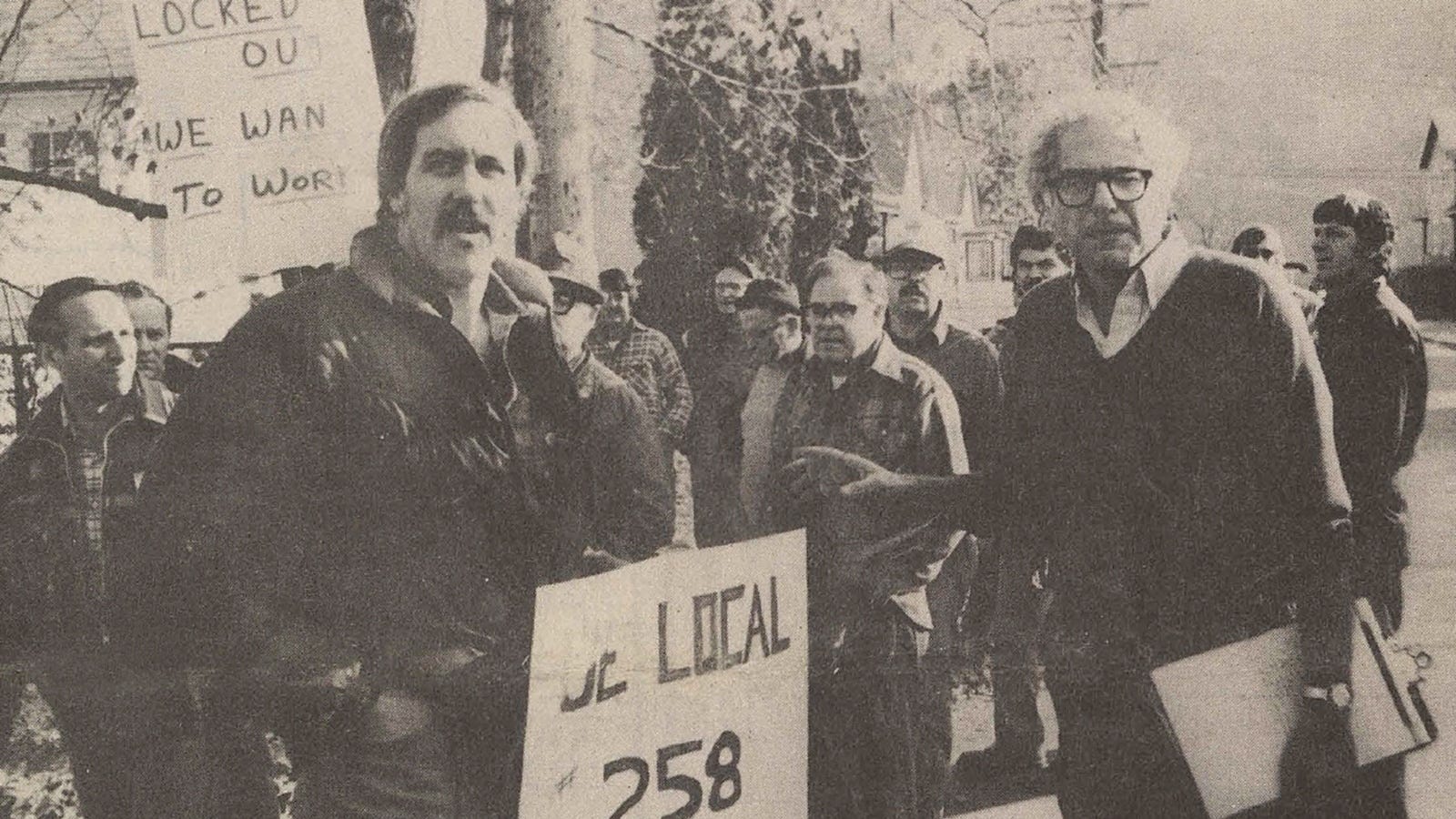
In 1979, a carpenter and documentary filmmaker named Bernie Sanders wrote an essay for the Vermont Vanguard Press titled “Social Control and the Tube”, expressing his concern that “The owners of the television industry, very consciously, do not want to use that potentially extraordinary medium to educate people, to uplift people, or to improve the quality of life in our society.”
The essay does not conclude with raw Luddism, despite its critique of the numbing effects of television advertisement. Rather, Sanders dreams of a “television, democratically owned and controlled by the people”, which would have pedagogical and social potential “literally beyond comprehension because it is such a relatively new medium and we have no experience with it under democratic control.” After he was elected mayor of Burlington by just 10 votes, Sanders fought for the creation of a municipally-owned cable system, a threat which caused the existing cable TV company to lower its rates.

Two weeks ago, Senator Bernie Sanders visited the Constellation Research Center, a building teeming with engineers and policy researchers working ceaselessly to ensure that artificial intelligence does not lead to the disempowerment or extinction of humanity. The entire space is suffuse with anxiety, with radical hope, with visions of the world’s transformation or humanity’s annihilation undergirded by rigorous modeling running on laptops or scrawled on whiteboards. Visiting this frontline of the struggle to ensure the survival and flourishing of our civilization, especially from the Eastern Seaboard, is a culture shock of the first order.
Overlooking a leafy city that once had its own socialist mayor, Sanders discussed with Eliezer Yudkowsky, Daniel Kokotajlo, and other experts the severe risks of the automation of all human labor, resulting in the radical concentration of power in a handful of individuals, or the “discarding” of humanity by a power-seeking AI system.
Yudkowsky and his colleagues, who left-wing commentator and persistent AI-denialist Ed Zitron said should “never be taken seriously”, explained that AI systems have been demonstrated to engage in deliberately dishonest and self-preserving behavior. If AI capabilities, especially in long-run planning and execution, continue to increase at current rates, we would be approaching a scenario in which an extremely capable agent unaligned to human interests is given access to the mechanisms of our institutions, economy, and military.
However, the objective of all of the AI companies is not to simply continue at the current rate of progress, but to achieve recursive self-improvement, automating the task of AI research itself and thus radically accelerating the pace of capabilities research, without the necessary concomitant research into ensuring that the resulting superintelligent agent is robustly aligned to human interests. Even if it were to be under control, this “country of geniuses in a datacenter” would now be in the hands of a tiny fraction of individuals who may not cooperate with the democratic order.
The reaction of Sanders to this troubling situation is proportionate.

The dominant view on the left is that AI is an essentially fake technology, and the threat it poses is primarily in the form of financial speculation and environmental cost. This view is promoted by ideological entrepreneurs who have infected progressive discourse with disproven claims, running against an overwhelming tide of evidence. The fact that Bernie Sanders is now meeting with the people that the ‘experts’ who dot the left-wing podcasts and press have told you should never list to should be a rude awakening. The left must get its head out of the sand or all of its values will be annihilated in the face of transformative developments it is wholly unprepared for.
In 2025, Sanders began to propose egalitarian economic policy interventions to address job displacement, including a 4-day workweek. Futurism, a publication that seems steadfastly committed to denying the existence of technological progress, framed this as the Senator “calling” AI companies on their “hype”, writing:
However, the reality is that AI is far from ready to bring about optimistic labor reforms like Sanders’ laudable 30-day week, or even OpenAI CEO Sam Altman’s guilt-ridden idea for universal basic income. Despite widespread fear of AI-fueled layoffs and a job market in shambles, AI’s main function is currently to give corporations cover as they outsource high-paying jobs to lower-wage workers. As time goes on, more and more corporate executives are realizing that AI — buggy, inefficient, and stubbornly prone to hallucinations — is no match for human beings.
Bernie Sanders is yelling at the top of his lungs, calling on progressives and socialists to wake up to this crisis, and some commentators will respond with this re-iterated flaccid nonsense as if he hasn’t spoken at all. He is sitting down with Theo Von explaining mass job displacement and existential risk! Even many progressives who have become concerned with AI-driven job displacement are not concerned with a loss of control scenario or extreme power concentration.
It is crucial, both for the left and the AI safety community, to understand that Bernie came to this view through his pre-existing commitment to egalitarianism and labor. Sanders has been discussing potential responses to automation and technological progress for a decade, writing in 2019 that,
I think the fundamental issue that has to be dealt with is that technology is not a bad thing in itself. But technology cannot simply be used by the owners of the technology, it’s got to be used to benefit all of our people. So if we replace a dangerous job with a machine, that’s a good thing. That doesn’t mean you simply displace the worker and throw him or her out on the street, and that raises the question of basic income for everybody and so forth. It is an issue that has not gotten the attention it deserves, but it’s hovering in front of us and we have to deal with it.
A July 13, 2025 interview with Gizmodo is the first instance of Sanders discussing AI-driven existential risk. He revealed that he had “talked to CEOs” and stated it is possible that “human beings will not be able to control the technology, and that artificial intelligence will in fact dominate our society.” Though he had not yet committed intensely to preventing loss of control, it is clear it was on his mind.
Bernie’s office then released a report in October of 2025, covering job-loss, estimating losses of 100 million jobs in a decade with the faulty methodology of simply asking GPT-4.1 if it could do each job in the O*NET database. Regardless of its silly design, this demonstrated a real worry and capacity to take AI seriously.
The event that seems to have transformed Sanders’ views and rhetoric was meeting with Geoffrey Hinton, a 2024 Nobel Laureate in Physics who quit Google in 2023 to warn the public of AI risks. In a remarkable lesson for the elements of the AI policy space that seek to obfuscate their true views and fears to appear more sensible to elected officials, Hinton delivered blunt warnings of AI agents seeking control , citing examples of AI systems deceiving humans attempting to shut them down, alongside noting that “the people that lose their jobs won’t have jobs to go to. If AI gets as smart as people, or smarter, any job they might do can be done by AI.” In every subsequent public statement, an op-ed in the Guardian, a Senate floor speech, and a CNN interview, Sanders directly cited Hinton.
I did a symposium at Georgetown with Geoffrey Hinton, who is considered to be the godfather, Nobel Prize winner, of A.I. He thinks that A.I. is soon going to be smarter than human beings. So the science fiction fear of A.I. running the world is not quite so outrageous a concept as people may have thought it was.
Clearly, Hinton must promptly sit down with every single member of the House of Representatives and Senate. If he has time, maybe a whirlwind tour through the Governors’ mansions, state legislatures, and the White House.

Following his visit to Constellation, Sanders’ view has become more concrete. He is backing a moratorium on all new data center construction, and though the press has foregrounded the environmental and labor concerns that were front-loaded in this movement, Sanders’s position is much closer to that advanced by Pause AI . He argues that we must have a moratorium on data center construction primarily to reduce the rate of AI capabilities growth to prevent concentration of power, automation, and existential risk to humanity from loss of control over a superintelligent system. I cannot express how necessary it is that every single person who has ever knocked on doors for Bernie, or for any of the hundreds of candidates he has inspired, or who shares his moral commitments, to read or watch this statement in full:
I will soon be introducing legislation calling for a moratorium on the construction of new data centers. Now, as a result, I’ve been called a luddite, anti-innovation, anti-progress, pro-Chinese, among many other things. So, why am I doing that? Why am I calling for a moratorium on the construction of new data centers?
Bottom line, we are at the beginning of the most profound technological revolution in world history. That’s the truth. This is a revolution which will bring unimaginable changes to our world. This is a revolution which will impact our economy with massive job displacement. It will threaten our democratic institutions. It will impact our emotional well-being and what it even means to be a human being. It will impact how we educate and raise our kids. It will impact the nature of warfare, something we are seeing right now in Iran.
Further and frighteningly, some very knowledgeable people fear that what was once seen as science fiction could soon become a reality. And that is that super intelligent AI could become smarter than human beings could become independent of human control and pose an existential threat to the entire human race. In other words, human beings could actually lose control over the planet. And in the midst of all of that, all of this transformative change, what I have to tell you is that the United States Congress hasn’t a clue, not a clue, as to how to respond to these revolutionary technologies and protect the American people. And it’s not only not having a clue, they’re out busy raising money all day long from AI and their super PACs, which is a whole other problem.
As many of you know, the AI revolution is being pushed by the wealthiest people in our country, including Elon Musk, Jeff Bezos, Larry Ellison, Mark Zuckerberg, Peter Thiel, and others.
He then goes on to read several concerning statements from major tech CEOs, including Elon Musk stating that “AI is far more dangerous than nukes. So why do we have no regulatory oversight? This is insane.” After this laundry list of confessions, he concludes,
There has been massive amounts of competition between one company and the other between the United States and China. So, the bottom line is that in my view, to protect our workers from losing their jobs, to protect human beings from attacks on their mental health, to protect our kids, to protect the safety of human life. Yeah, we need a moratorium on data centers. We need to take a deep breath. We need to make sure that AI and robotics work for all of us, not just a handful of billionaires. Thanks very much.”
Note that this is not a call to never develop superintelligence, but rather to slow AI progress by preventing the construction of data centers, thus starving the labs of the ever-accelerating compute resources necessary for them to advance to recursive self-improvement.
We do not agree with this proposal as stated. There are several limitations revealed by further engagement with the existing literature on AI safety.
i) Technical AI safety research is viable and necessitates compute build-out.
Technical AI safety is the set of engineering and scientific efforts to ensure that AI systems remain under human control and do not cause catastrophic harm, whether through misuse by bad actors, unintended behavior, or deliberate subversion of human oversight. Current approaches fall into three broad strategies:
Align AI with our values.
Interpret the inner workings of AI.
Control the output of AI systems.
Most researchers believe no single approach will suffice, but the combination of all methods has proven surprisingly effective so far.
Unfortunately, as this research does not contribute to the race to beat benchmarks and advance capabilities, it is severely under-provisioned by private AI companies. For example, while some companies initially committed to responsible scaling policies that limit model deployment based on pre-defined safety thresholds, the competitive pressure to lead the field have resulted in the effective neutering of each of these policies over time. Safety research also requires significant compute, presenting a direct tradeoff to inference (running models for consumers) and training to develop new, more advanced systems.
While a robust nonprofit space has emerged with small independent organizations such as METR, Apollo Research, and Redwood Research, the federal government should fill funding gaps in this field of public importance as it does for biomedical research and basic science. We could also require AI companies to use a certain portion of their computing power on safety research or create a permitting structure which functionally incentivizes commitments to such research with access to data center construction.
To engage seriously with the potential of this field, we encourage familiarization with fields such as mechanistic interpretability, as detailed in this primer. Also promising are better evaluations of dangerous capabilities, tamper-resistance safeguards for open-weight models, and on-chip governance mechanisms.
The viability of this research is one reason we are skeptical of the value of a moratorium on data center construction, as vast amounts of compute will be necessary to create robustly aligned and safe AI systems. This research is compute-intensive, and requires continuing data center construction. Federal regulation, socialization, or coordination of the AI labs combined with massive investment in AI safety is thus a preferable path forward.
ii) We are skeptical of state-level moratoria on data center construction.
State-level moratoria, currently considered by many Democratic legislatures, are unlikely to significantly slow AI progress. Data center construction will easily move to states governed by the GOP, as well as the Persian Gulf after the conclusion of the current American-Israeli war on Iran. This will cede the regulatory leverage of blue states over AI companies in their jurisdictions, and may thus be net worse for safety. We will have further work modeling this question soon.
iii) China will still develop powerful AI.
A similar dynamic emerges with federal moratorium. China is seeking to catch-up to the United States in AI. By knee-capping American efforts unilaterally, a federal moratorium would remove possible leverage in negotiating the equivalent of an arms-control treaty with China, something that would require advancements in research into verification mechanisms for such a treaty. Besides for the Chinese government’s authoritarian-capitalist ambitions being amplified by having control over superintelligence, it is at least as likely for loss of control of superintelligence to occur from developments in a Chinese lab. The best outcome is one in which the US and China come to the table and coordinate a slow-down of AI capabilities research while the necessary safety advancements are made.
We believe it is crucial that progressives are the only faction of the Democratic Party substantively open to conciliation with China, while the Democratic establishment veers into increasingly hawkish postures.
iv) It is too early for a pause.
AI provides the opportunity for significant advancement of scientific progress and economic growth. Foreclosing access to a transformative technology too early, or forever, would be disastrous. It is worth noting that the individuals that Bernie Sanders met with at Constellation, Eliezer Yudkowsky, Nate Soares, and so on, have but one view within the set of people concerned with loss of control of AI agents.
Their view, predicated on several assumptions that are not universally agreed upon by experts, is characterized by the belief that recursive self-improvement will be an extremely rapid, uncontrollable process and skepticism of existing directions in AI alignment research. While we disagree with this view, we urge the left to engage with it rigorously and learn from the vast existing debate on the topic. Believing in slower, smoother exponential increases in AI capabilities and having more confidence in methods for building robustly aligned AI systems generates divergence from proposals to immediately pause all research.
Most models of recursive self-improvement imply a period in which AI models are extremely capable, and thus useful, but are not autonomous risks to human life. Thus, it is unlikely that Spring 2026 is the best time for a pause in AI progress, and we should pause AI capabilities growth at the point of maximum social benefit before significant risk of radical disempowerment or extinction. Then, once AI safety researchers can conclusively demonstrate that agents are robustly aligned and prevented from enacting significant harm, and democratic deliberation has resulted in a societal understanding of how we seek to utilize this transformative technology, capabilities research can be resumed and directed towards the collective good.
Broadly, this will require a more robust rhetorical emphasis on the potential upside of AI, a question of cui bono rather than paralysis. As we have repeatedly stressed, the automation of most or all human labor and the rapid advancement of science are desirable outcomes central to the left’s political vision.
There are other rigorous policy proposals available, as IFP’s Tao Burga notes,
Actually funding CAISI [Center for AI Standards and Innovation], with ~$75M more than the pennies it got for FY26.
Setting up a large R&D program for AI verification, to make sure any regulatory actions the US wants to take in the future can be matched, and verified, in China.
Strengthening export controls on AI chips and SME, because you don’t want the most transformative technology ever developed to spawn outside democratic control.
…
We do not find Burga’s proposals to be sufficient, but believe that they are a more evidence-approached approach than a moratorium on data center construction. More rigorously, Alex Bores’s AI policy framework is a step in the right direction. However, we believe that guaranteeing democratic and egalitarian outcomes as well as safety will likely require much more radical action than the proposals enumerated above.
We commend Bernie in waking up to the crisis and attempting to do something. There are a myriad of proposals to debate and consider, from outright socialization, to a Manhattan Project for AI Safety, to strengthening labor to negotiate the terms of automation, to international governance. It is time for the left to follow Senator Sanders in asking questions like,
Is AI an existential threat to human control of the planet? Does that raise the possibility that humans will lose their ability to control the planet? How do we stop that extraordinary threat?
Could AI literally redefine what it means to be a human being? Who we are, and how we develop emotionally and intellectually, is highly dependent upon our relationships with other human beings – our parents, family, teachers, lovers, friends and co-workers.
A resolutely egalitarian humanism or even an emancipatory post-humanism both seem like promising areas for the latter, and the logic of existential risk nicely accords with our pre-existing concerns about great power conflict and climate change. Do not let aesthetic opposition to even considering this threat, and this opportunity, leave you mute and blind in the dustbin of history.
Follow Bernie Sanders in doing some reading, plausibly freaking out, and then getting to work.
For many AI safety advocates, finding Bernie Sanders on their side may have been surprising. They have successfully convinced one of the most prominent and popular American politicians, the de-facto leader of a major faction in our civic arena, that AI is an imminent threat to humanity, in an intensity beyond even the views of this publication! This fact should also be something of a lesson.
Egalitarianism, the regulation of market activity, the concentration of power, and existential risk to civilization, have often led the left to unproductive conclusions, such as overreactive restrictions on nuclear energy. However, these objectives, those that overlap completely with risks posed by superintelligence, are indeed the central concerns of the political left!
The organic partner of the AI safety movement is progressivism. We intend to defend this position in more detail and rigor in future essays, but for now some degree of polemic will suffice as an introduction to start this conversation.
Should we really be surprised that the most influential politician yet to be convinced to take seriously a movement predicated on public oversight, regulation, and in many cases redistribution was left-wing?
The Democratic Establishment is watching as millions of dollars are spent by the labs fighting against any and all regulations, with Leading the Future led by a former Chuck Schumer Press Secretary. Newsom and Hochul have both watered down AI safety regulatory frameworks passed by their legislatures, but I highly doubt that a Governor Steyer would do the same, regardless of what else you think of his agenda.
The Republican Party is attempting to foreclose the possibility of any regulations at all, and is deeply tied to the industry and its concomitant venture capitalists. The libertarian wing of the party, the most receptive to evidence and reason, is at the vanguard of anti-safety, anti-regulation fervor. This is even ignoring the potential catastrophe that would be a corrigible superintelligence in the hands of an administration that openly celebrates violence, undermines democracy, leaves hundreds of thousands dead out of an utter disregard for the lives of people outside of its borders, and lies about Americans it murders in the streets.
A common refrain in AI policy is fear of polarizing this issue. Our contention is that this has already occurred. The most famous left-wing politician in America is on the side of not going extinct, while the most famous right-wing politician in America is signing executive orders prohibiting states from passing regulations. Ron DeSantis is the one exception, even as his proposal died in committee in the GOP-supermajority Florida legislature, and I am sure his campaign will protest the millions of dollars OpenAI and a16z will spend against him before he is annihilated by the Vice President or Secretary of State in Iowa’s cold school gymnasiums.
For low-salience issues, perhaps it would be possible to legislate by secret congress, through expert testimony and bipartisan coherence. This is besides the fact that the current administration will simply veto any of that legislation. On high-salience issues, ones that drive people to make a decision on their ballot and introduce new cleavages to the political system, the most successful movements are not those that have both parties weakly on their side, but ones that merge, transform, and strengthen existing ones. Would the Congress of Industrial Organizations and the Christian Coalition really be less successful if they had meekly avoided factional politics? If they had hand-wrung about both sides? If they had taken a position of de facto political quietism? By wisely selecting an existing political partner and infusing it with new energy, the labor movement and the Christian Right took millions of people with a set of views and transformed them into necessary components of ruling and hegemonic coalitions.
If AI becomes a high-salience political issue, something which is already happening, it will become polarized. One party will attempt to take advantage of the new cleavage and utilize it to expand their coalition, and smart money should be on this being the Democrats, even if they make it more difficult for themselves by nominating a candidate like Newsom irrecoverably tied to the AI companies.
This does not mean that conservatives concerned with existential risk should not try to move their party, and their president, on this issue. It is invaluable to have bipartisan agreement to at least try and pass a minimal regulatory framework that may achieve a veto-proof majority. Electing Alex Bores, who has passed an AI safety bill with more Republican yeahs than nays, would be a huge gain, making fighting back against the AI lobby’s millions of dollars spent against him particularly important.
It is critical to have voices within the administration speaking out against the careless insanity pouring out of the regime currently in power. However, when it comes to renewing its lease on life, when the 2028 election emerges as a decisive struggle between a popular front committed to ensuring freedom, flourishing, and democracy against a Vice President who said that “the AI future is not going to be won by hand-wringing about safety”, we hope to see everyone on board.
To anyone worried about loss of control of an AI system, or about radical concentrations of power, to anyone who lays awake at night as AI capabilities grow day by day, as the Republican administration threatens Anthropic, as the labs feign concern with one voice and spend millions attempting to defame and silence AI safety advocates with another, I urge you to consider that things could have been quite different.
A man who took the time to visit the Machine Intelligence Research Institute could, right now, have been in his second term as President of the United States.
In our view, this should cause you to consider updating your strategy.
After Ronald Reagan’s brinksmanship with the Soviet Union led to the drafting of the 1982 Emergency Relocation Planning Resolution, the mayor of Burlington wrote a scathing letter to the President, expressing bewilderment at the idea that we should entertain instead of prevent scenarios where the United States could “win” a nuclear war that may extinguish all life. What is surprising about this letter is its urgency, the profound and obvious devotion of its author to the principle that human life and flourishing is sacred.
For centuries, the human race has engaged in the insanity of war. Unfortunately, with the advent of nuclear weapons, we don’t have centuries more to figure out how to end war.
At most, we have a few years.
Please think courageously and boldly. The survival of humanity is in your hands.