


It’s becoming clear that current growth in the US economy is primarily driven by AI. Tech companies are spending hundreds of billions of dollars to build infrastructure that will scale current Large Language Models into—hopefully—a transformatively valuable product. The US economy has become dependent on hyperscalers: vast data management and cloud computing centers. It would be very bad if hyperscalers were an existential threat to the environment or a sufficiently large danger to human health.
Are Hyperscalers Destroying the Planet?
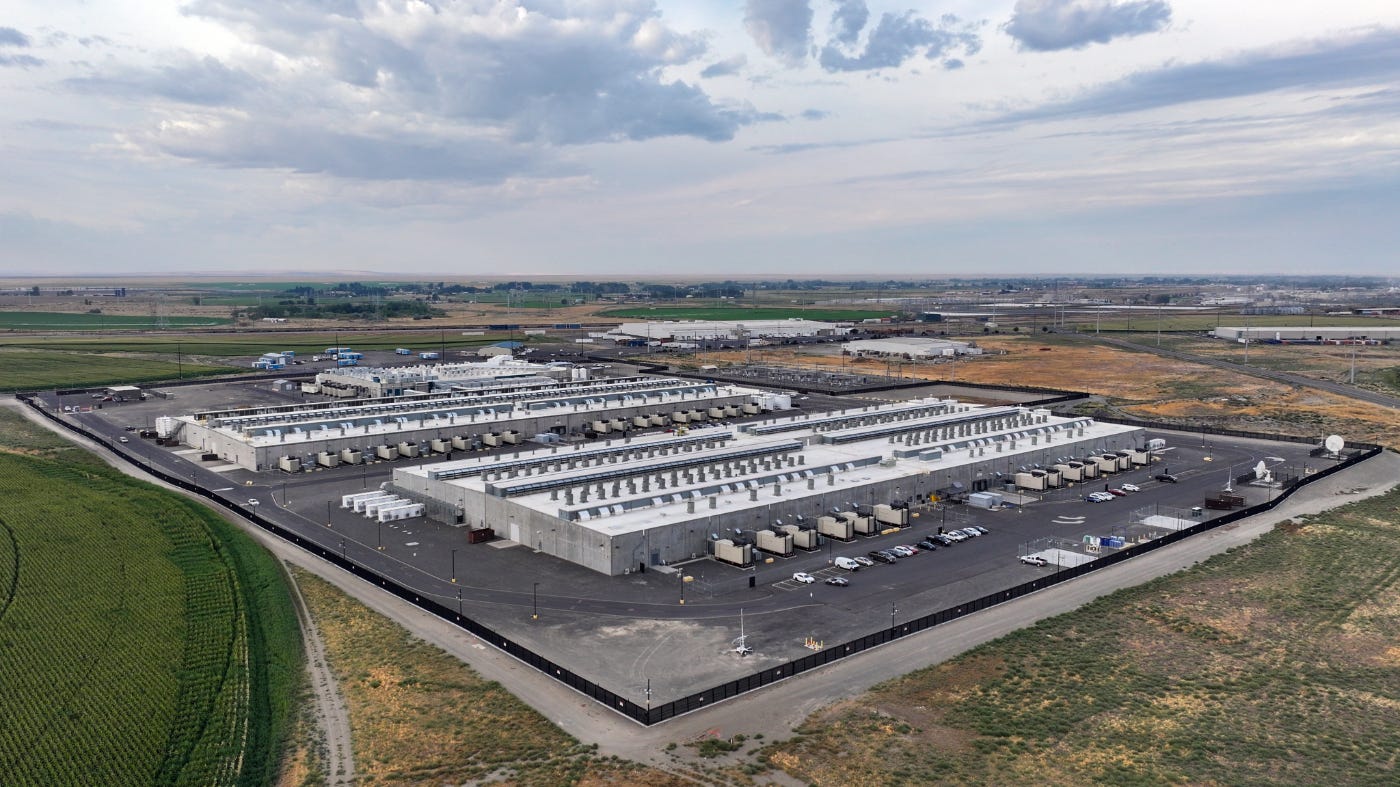
Data centers are expected to consume 6.7-12% of total US electricity by 2028, or 325-580 TWh. Certainly, this will be a challenging task for the electrical grid to face. However, this is barely a drop in bucket of global energy consumption, which is over 180,000 TWh already. Preventing the construction of hyperscalers would not make a meaningful difference to climate change. Given the unprecendented amount of capital put into these projects, sufficient political pressure could drive investment into expansion of the grid and green electrification.
When data centers are built faster than they can be connected to the grid, temporary use of diesel generators can create serious atmospheric pollution. xAI’s data center in Memphis has increased peak nitrogen oxide levels by 79%, using almost double the legal number of turbines. That said, completed data centers tend to abide by the EPA’s limits on atmospheric pollution. In this way, a fast expansion of the grid is necessary to prevent nearby communities from suffering environmental illness. We can build our way out of this.
It is harder to build our way out of water scarcity. In Texas, data centers consume a quantity of water that could supply millions of households while the public is forced to ration water use. There’s real costs to the public when data centers are built in drought-prone communities, which is (or will soon be) the case for 40% of US data centers. That said, there are certainly regions of the US where water is plentiful and residential demand is low—prime candidates for responsible data center development.
But if you read into complaints of communities protesting data center development, there’s another issue a well-regulated, cleanly powered, water-rich hyperscaler would still run into. A byproduct of our digital infrastructure entirely unrelated to scarcity, more immediately salient across party lines than long-term environmental change. It’s the hum.
The Hum
Hyperscalers can get very loud. One father described his son having nightmares that the Hum of a data center was a spaceship coming to abduct him. Advocates against data center development describe the Hum as louder than a rock concert. If these are the stories you hear about living next to a data center, you don’t need to be a member of the Sierra Club to want the Hum out of your backyard.
This isn’t purely an aesthetic concern. Long-term exposure to noise pollution correlates with an increased risk of heart failure likely mediated by an increase in oxidative stress. You can infer from here what a series of other studies suggest; noise pollution may impact the development of alzheimers, classroom behavior, and every other health/behavioral outcome stress mediates.
Given animal populations have evolved to specific spectra of noise, lower levels of noise exposure could increase the prevalence of diseased wildlife and alter ecological patterns. One study shows that intense noise pollution can decrease tree proliferation long after the source of the noise is removed.
Luckily, hyperscalers aren’t that loud all the time. Construction is loud but temporary. As long as the center is connected to the grid, the backup diesel generators responsible for most atmospheric and noise pollution are only tested monthly.
Still, if you’re really close to a data center, there’s a Hum. It’s too low to raise public health concerns. It’s much too low pass the threshold for local noise ordinances. But if you moved out to rural America because of a strong desire for peace and quiet—or view the land around the center as sacred to your community—you may have an unassailable preference against that Hum.
I live in New York City. It’s technically loud, but I don’t hear the Hum. I decided long ago that whatever costs ambient noise may impose are outweighted by the culture, economic opportunities, low-cost public transportation of the city. You only hear the Hum if you feel like noise has been forced into your life without your say.
Distributed Trade-Offs: Your Backyard is the Global Economy
If I want affordable housing on my block while my neighbor thinks that would ruin the skyline, we don’t have to duke it out. We can democratically decide the future of our community.
But not really. The places these arguments get hashed out are small community board meetings where only the polarized with free-time are incentivized to attend. Even beyond this—in our example housing debate—how do we consider the will of people who would move into my neighborhood if the cost of living went down? The effects of municipal policy leak beyond the purview of community boards. Should all those affected not have a say?
American democracy occasionally grants random citizens power they never asked for. Just as the suburban Pennsylvanian holds the glorious burden of choosing the President every 4 years, so too residents in data center hotspots will determine how fast the American economy will grow for the rest of the decade. These people shouldn’t suffer unregulated pollution to maximize GDP, but it’s important for our modern day Cincinnatus to hold a sense of civic duty beyond their backyard.
There’s local benefits to be considered as well. Property tax and the purchase of electricity from public utilities can raise significant funds for municipal government.
Unfortunately, these small government bodies often bend backwards to provide tax cuts and electric subsidies, putting the cost of data center development onto the taxpayer. There’s really no reason to do this; the demand for hyperscalers is so high that companies are willing to expend capital to invest in transmission and build private power alternatives.
This is just one reason residents become suspicious of the institutions that are supposed to represent them. Hyperscalers are the largest project many municipalities have ever considered. For residents, it’s easy to imagine a small town Economic Development Committee Chair not being able to resist the sci-fi prestige and big numbers of the largest companies on this planet. If you don’t trust your government to hold AI companies accountable, regulations requiring extra sound-proofing or limited diesel usage ring hollow.
Furthermore, the American public is pessimistic about AI’s impact on job creation. While similar types of development are defended on the grounds of job creation, hyperscalers only produce jobs on the scale of hundreds per facility. Given the productivity gains of AI haven’t poured down into the hands of the average American, it can seem like residents being asked to let Big Tech hike their utility bill so American jobs can be automated away. When politicians make shady backroom deals to build infrastructure for services that aren’t making money yet, it’s hard for citizens to tell the signal from the noise.
If we want a democracy that builds through the Hum, everyone needs to take a good look at their cards, then put them on the table. AI companies need to pitch something beyond a bill of superintelligent goods to working class Americans. Data center developers need to pick their locations wisely and send human representatives. Public representatives and servants need to do the research, have a backbone, and engage in good faith with their community. Community organizers need to protect their communities while recognizing trade-offs.
For this to be a fair negotiation, the scale of public and government coordination needs to match corporate scale: national.
The federal government needs to coordinate with the states to ensure municipalities have the economic information and political might to understand and communicate the trade-offs of data center investment. Coordination would be especially useful to avoid oversupply, preventing an AI bubble. Since the Republican-led House passed a ten-year moratorium on all AI regulation before it was cut by the Senate, I am skeptical the Trump administration will be open to any slowdowns.
If you are a committed conservationist who believes there should be no new data centers, the Sierra Club is doing a fine job.
If, instead, you believe there is some number of stressed out deer that is worth reducing poverty, there’s an open niche for a national organization dedicated to the well-being of working people over the profits of Big Tech. This organization would be driven exactly by its concern for climate change and public health to champion a fast rollout of renewable energy and clean electrification. Certainly, if that organization is experiencing an inflection point in its history, it could latch onto a growing issue like this to gain credibility in regions they struggle to connect with. They could even support activist members of the community in running for local office, both expanding its legislative influence and putting trust back into politics.
In every hyperscaler noise complaint, there is a latent political movement with a positive project of responsibly-powered AI for the public good just hanging in the air, waiting. The worst part about the Hum is—once it gets too loud—you have to yell to make yourself heard. We need a vision for the future that cuts through the noise.
Post-script: China is About to Solve This
You could also just Put It In The Ocean.
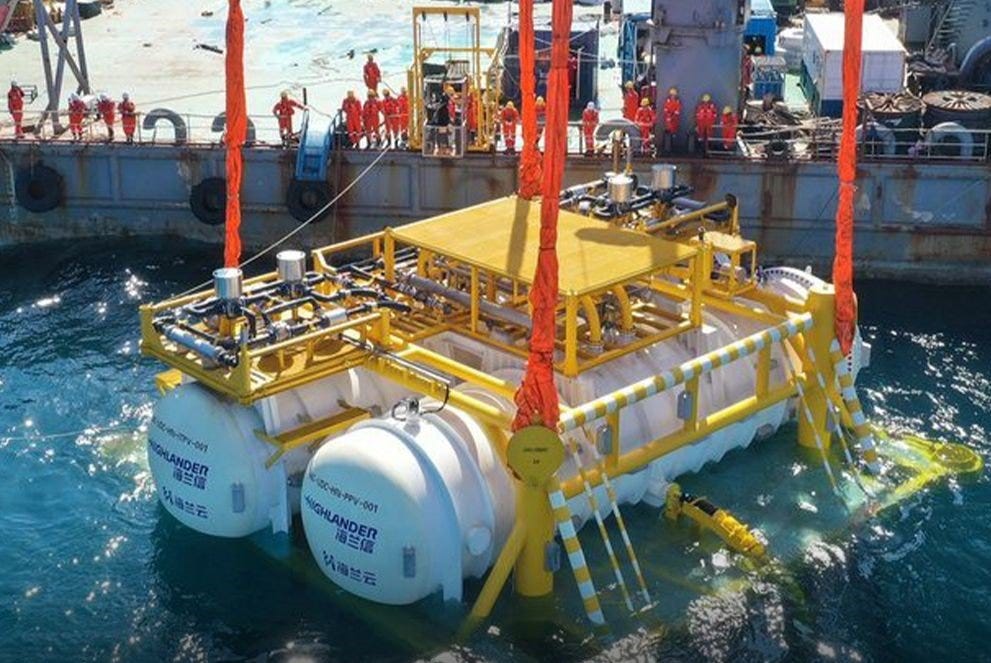
After a pilot program in Hainan, Hailanyun is building a small datacenter underwater off the coast of Shanghai. This solves all the problems I’ve brought up. They consume less energy to cool; this center will be 97% powered by a nearby wind farm. Nearby water temperature is projected to increase by less than 1 degree. They require no water consumption. There’s no Hum.
If all goes well, Hailanyun plans to rapidly expand production.
When I heard about this, my mind went immediately to the most poetic solution: fill the San Franciso Bay with underwater data centers. I’m not the first to think this. YC-backed NetworkOcean launched a pilot data center in 2024 to immediate regulatory critique, but the results are unpublished. Apparently you can reserve GPUs on their website now. Peer start-ups like SubseaCloud are trying to scale this idea as well.
All of this is building off Microsoft’s Project Natick, an underwater data center which completed a successful two-year pilot in 2020. As of 2024, Microsoft has not built other underwater data centers. It remains unclear why this tech has not been scaled.
