This week, Jacobin has thrown its red beret into the data center debate. On one side, Holly Buck argues moratoria alone are an insufficient program to ensure the democratic governance of AI. On the other, Aaron Regunberg claims data center resistance provides a nationwide movement that could change the balance of power between working people and Big Tech. Which side is correct? Dear reader, they both are. In the spirit of fraternal socialist discourse, this week we will proceed dialectically.
In short, for data center moratoria to build a working class coalition, they must unify their diverse coalitions around an explicit positive vision for what the pause should achieve. Without this vision, moratoria will become the end-goal itself, and yet another opportunity to democratize technological advancement will pass us by.
Diverse Coalitions Need Shared Goals
Holly Buck argues that moratoria aren’t a substitute for actual AI governance. Her argument that a US moratorium merely forces data center production to jurisdictions with weaker labor and environmental standards is a serious critique internationalists should consider. It is, in fact, quite possible for us to decarbonize data centers on a technical level, it just takes political will. That said, her vision of AI as a utility seems, if not ill-conceived, ill-timed; we’re at a point where abundant and cheap AI sounds more annoying than helpful to anyone who isn’t a Claude Code power-user. However, Buck makes a strong case that moratoria are not desirable as an end itself, and that the opportunities in AI governance go beyond regulating construction.
Regunberg sees Buck as arguing against a strawman. Regunberg argues that Buck “seems to misunderstand the thrust of the data center moratorium effort, which is to stall the breakneck development of these projects so we can enact ‘Actual AI governance.’” As evidence, he points toward a “comprehensive suite of actionable steps” as his governance strategy. Notably, all of these steps are on the regulation of data center construction; they don’t say anything about the governance of AI. Certainly the mitigation of local harms is the minimum viable policy that could organize the diverse parties opposing data center construction. But it is just that: the minimum.
If organizers like Regunberg want to “raise class consciousness” with moratoria advocacy, we need to raise these legitimate but local disputes towards universalist concerns. What does that policy look like? Given Regunberg positively cites Alex Bores, a Democratic Candidate for Congress in NY-12, I would imagine he would also support policies like the RAISE act that establishes safety standards for frontier AI or a public AI Dividend. The Justice Democrat insurgent Saikat Chakrabarti’s AI policy positions him to Bores’ left on labor, demanding gains from AI go towards a 32-hour work week & supporting the PRO act to grow union power. Both of these platforms include data center governance as one plank of a larger vision of progressive AI governance including AI Safety and worker’s rights—each components of a majoritarian coalition that could change the balance of power between working people and the tech industry.
The Purpose of a Coalition is What it Demands
Unfortunately, the coalitions calling for data center moratoria do not seem to share that vision yet; among all state-level moratoria bills, none of them make demands that expand outside of data center governance. Every moratoria provides a sunset clause—conditions at which the pause would end. The majority are time-based, demanding a 1-3 year pause. Many of those specify some action to be taken during the pause—such as an environmental study or future legislation—but not all. A few base their sunset clauses on the passing of future legislation. If moratoria make legislative demands at all, they never make demands about how to govern AI.
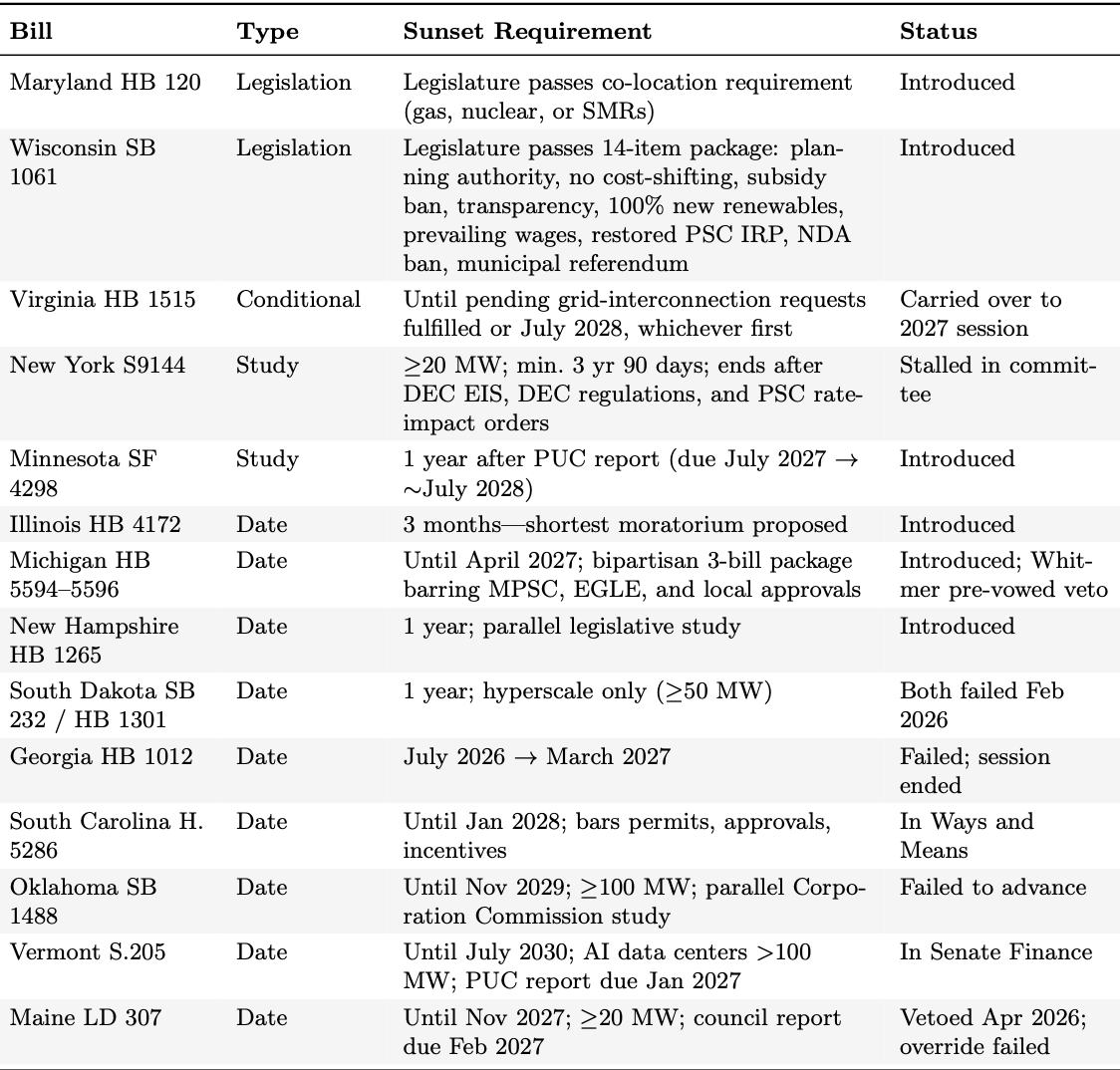
Why would we want a pause with no demands? Why would we pass a pause that demands specific future legislation when we could just pass that future legislation? To some degree, Buck is vindicated; many people who support moratoria see a pause as the end goal itself.
Across party lines, people commonly believe that AI is a bill of goods from Big Tech like crypto or social media. Of course, I disagree: AI capabilities are advancing rapidly and it is incumbent on the Left take that fact seriously and socialize its benefits.
However, Regunberg offers an alternative explanation:
“The problem is not that we don’t have policy solutions to this crisis. The problem is that Big Tech’s private (and unpopular) investment in data centers is moving at an astounding pace and we don’t have the time or leverage to establish the regulatory framework necessary to make this system work for the public.“
This makes some sense for governing the construction of data centers. If you can stop the concrete from pouring, you buy some time for your legislators to study up on the issue, negotiate with developers, and get these centers built cleanly without hurting rate-payers. In fact, where state-level moratoria are introduced, they often act as a maximalist anchor to transfer community-level pressure campaigns onto a package of passable data center bills that implement immediate changes to tax credits and utility rates.
But governing AI must extend beyond governing data center construction. If we have the policy solutions for AI governance, and we have the grassroots political anger against “the greed and avarice of an industry that is endangering our democracy,” then why have we failed to channel that political will into legislation that would protect and empower working people?
Buck suggests that this might be because data center opposition is defined by the interests of middle class incumbents, incapable of supporting a working class politics.
Of course, data center opposition has no essential class or political character, but is a diverse movement that spans from rural NIMBYs to Brooklyn socialists. It is incumbent on the leftists organizing in these spaces to prove Buck wrong by championing legislation that protects people not only as ratepayers and residents of a neighborhood, but also as workers of a class and citizens of a global community.
To address job displacement and economic uncertainty, this could include expanding bargaining rights, severance taxes on data center electricity consumption, or a state-level AI dividend for active redistribution. This also seems like an opportunity to draw attention to the safety risks AI poses, from the everyday problems of interactions with kids to the existential threats posed by biological and cyber capabilities.
This is the strategy of Senator Bernie Sanders and Congresswoman Alexandria Ocasio-Cortez.
Globalizing Data Center Discourse
The sunset clause of the Sanders/AOC federal moratoria—distinct from every state-level moratorium—is conditioned on future legislation that would protect workers’ rights and minimize existential risk. Sanders in particular has used this proposal as a platform to advocate for issues beyond and including data center construction; his “AI Data Center National Organizing Call” spends as much time talking about environmental damage and utility hikes as he does about job displacement and existential risk. His advocacy has connected localist concerns to not only federal AI governance but also international collaboration with China.
While Sanders actions have been providing a positive vision for how the Left could approach AI governance, I worry that the moratorium could become the goal itself. The bill’s sunset clause lists five reasonable demands covering safety, labor, and data center construction to end the pause. I doubt more than a fraction of the people that have heard about this bill could list those demands; most people could only tell you that Sanders supports a moratorium.
Here’s why we should be concerned about that: sometimes the policies presented to voters do not represent the policies that would achieve the outcomes voters actually want. If the only option you hear to stop unregulated data center expansion, job displacement, and existential risk is a moratorium, then of course you would support a moratorium. If that remains the case, populist candidates (or candidates that want to outflank populist opponents) will be forced into a bad equilibrium where the most effective way to communicate a willingness to protects the environment and working people with AI governance is by backing a moratorium.
But this risk isn’t unique to the federal moratorium; the state-level organizations leading this fight propose moratoria as a maximalist demand to build leverage for the rest of the bills in their portfolio, but the moratorium is the main piece the public hears about. In Georgia, the Sierra Club’s priority bills focused on transparency, cost-allocation, and an end to tax breaks. In Pennsylvania, PennFuture endorsed a statewide moratorium while also backing bills on protecting ratepayers and requiring clean energy, annual energy and water reporting, and a state-developed model municipal ordinance. Even in Virginia, the same coalition runs the same multi-bill strategy. It’s not that the people fighting for moratoria have no plan; it’s that those plans are split up across half a dozen bills per state and feel less radical than moratoria. The program is too fragmented to enter the public consciousness as a unified vision, so the moratorium sucks up all the air out of the conversation.
When we use moratoria as a maximal demand yet fail to convey a clear end-goal, the moratorium will become the goal itself. If we want to expand grassroots political anger to fight Big Tech into a political program that can meet our moment, we must communicate a clear and salient vision for AI governance that goes beyond the first step.