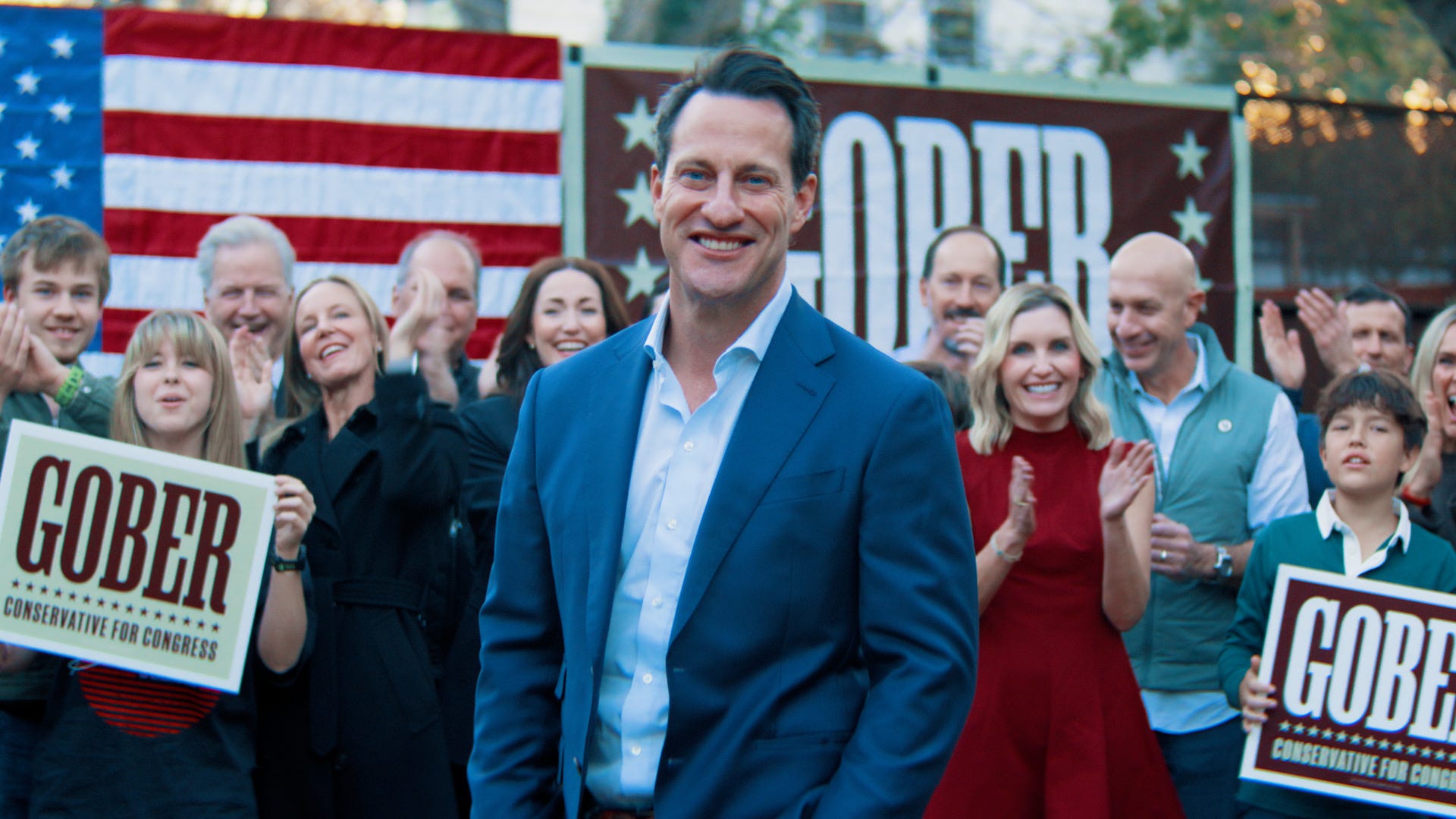
Leading the Future PAC, funded by a venture capital firm a16z and OpenAI’s Greg Brockman, and its affiliated group American Mission have spent $748,000 on independent expenditures supporting Chris Gober in the Republican primary for Texas’s 10th Congressional District. Most reporting on the AI lobby’s electoral activities mentions Gober in passing, as a secondary detail in stories about the group’s campaign against Alex Bores, the New York State Assembly member who sponsored AI regulation and whom Leading the Future has made a primary target. The PAC attacking an architect of AI regulation is easily explicable, but backing a candidate overwhelmingly likely to win and already endorsed by Donald Trump and Governor Greg Abbott is less legible.
Gober promises to “champion” the “world-class innovators” in his district and promote policies “that ensure America wins the global technology race.” He further devotes himself to “fight for policies that protect American innovation from China’s economic espionage and champion smart investments in American AI infrastructure that protect rural Texans from projects that drive up electricity rates and drain local water supplies.” American Mission’s first ads supporting Gober launched on December 10, 2025, one day before President Trump signed Executive Order 14365, which created an AI Litigation Task Force at the Department of Justice to challenge state AI laws and conditioned federal broadband funding on whether states adopt AI frameworks aligned with federal policy. The ads American Mission ran on his behalf call him a “Trump conservative” and a “MAGA warrior”, and reference “American technology investment right here in Texas, so we can defeat China.” Matching the PAC’s overall strategy, the ads never explicitly mention AI. Palantir co-founder Joe Lonsdale gave $250,000 to American Mission, making him the only itemized individual contributor to the group besides Leading the Future’s $5 million. Why is the AI industry’s political operation spending more on this central Texas congressional primary than on almost anything else?
Gober’s influence in campaign finance law is difficult to overstate, and the cases he has won have shaped the legal architecture that now enables the vast spending directed at his own campaign. In 2013, he argued Texans for Free Enterprise v. Texas Ethics Commission before the Fifth Circuit, clearing the way for unlimited corporate contributions to Texas super PACs. In 2022, he won FEC v. Ted Cruz for Senate at the Supreme Court, striking down the federal cap on using post-election donations to repay candidate loans. Widely recognized as an expert on campaign finance, he was appointed director, chief lawyer, and treasurer of Elon Musk’s America PAC, where he oversaw the deployment of approximately $263 million and defended the PAC’s $1 million giveaway program.
His compliance firm, RightSide Compliance, processes filings for Republican presidential campaigns and the major Republican committees. His institutional positions have tracked the Republican Party’s legal command structure at every level: general counsel to Ted Cruz’s 2016 presidential campaign, general counsel of the Republican Party of Texas from 2017 to 2019, general counsel of the National Republican Senatorial Committee, and deputy counsel to the Republican National Committee. After 2020, he defended Ken Paxton before the State Bar over attempts to challenge the 2020 election results in four other states. In 2021, he drew Texas’s congressional map.
In defense and intelligence, he has built an impressive operation that overlaps with his political work. He founded Maven Defense Solutions, which employs a former Deputy Assistant Secretary of Defense and former CIA officers. The related lobbying arm Maven Advocacy Partners represents a portfolio of venture-backed defense startups such as Radiant Nuclear (backed by a16z) and Sagint, which builds AI-powered intelligence tools for the Department of Defense. Simone Ledeen, the former DASD for Middle East Policy who works at Maven, simultaneously serves as a venture partner at Texas Venture Partners, a $50 million fund investing exclusively in Israeli defense technology startups. It is certainly strange, though possibly coincidental, that Gober’s defense consulting business shares a name with one of Palantir’s largest contracts, providing AI capabilities to the DoD under Project Maven.
In January 2025, Gober’s network expanded further by founding Lex Politica, which he told the New York Times would be a law firm “synonymous with the conservative movement.” Lex Politica’s clients include 20 Senators, more than 50 House members, the NRSC, the NRCC, the Republican Governor’s Association, and America PAC.
Chris Gober’s network in GOP politics is vast, but so are his connections to the AI lobby, to the organizations pushing for a national moratorium on state regulations on AI.
The American Innovators Network is the coalition backed by Andreessen Horowitz and Y Combinator that lobbies against state-level AI regulation. AIN has spent over $250,000 lobbying in New York alone against the RAISE Act, and $50,000 in digital ads targeting AI regulation bills in California. Its executive director, Vanessa Day, is an alum of Targeted Victory, the firm whose co-founder Zac Moffatt helps direct Leading the Future. Christine Fort, a partner at Lex Politica, is listed as a registered lobbyist for AIN in the California lobbying directory. Notably, Fort does not list this affiliation on her Linkedin.
The Koch network’s Americans for Prosperity is one of the leading organizations opposing state-level AI regulations. Jenny Kim, Lex Politica’s COO, was previously Deputy General Counsel at Koch Companies Public Sector, LLC.
Eric Wang, a Lex Politica counsel, was interim general counsel at AFP.
Matthew Dalton, Gober’s Political Director, is a former Amazon executive.
Gober was the primary counsel for political matters for Elon Musk, a man who said of his company xAI, that “I don’t think humans will be in control of something that is vastly more intelligent than humans.”
However, there is no public record of Chris Gober speaking on AI issues beyond limited statements concerning beating China while recognizing potential water use dangers from data centers. Occasionally, we get some hint of the sheer extent of his network in AI industry space. A Linkedin post by commercial real estate specialist Hannah Lindermann states that at a private reception, Gober spoke on “Texas’ growing water challenges.” The fundraiser was at the home of Stacy Hock, a member of Board of Advisors for the Joe Lonsdale co-founded University of Austin, and Joel Hock, a software engineer at Hudson River Trading, which has invested heavily in Artificial Intelligence. What he said during this reception is not available to the public.

Notably, Gober himself has published legal analysis on the regulation of AI in political advertising through his firm Vantage Legal PLLC, demonstrating direct expertise in the very policy area his campaign’s backers are spending millions to influence. In the piece, Gober surveys the federal and state regulatory landscape governing AI-generated political content, including state-level disclosure laws in Wisconsin, Florida, and Arizona, FEC guideline updates, and the FCC’s proposed rulemaking on AI in political ads. The analysis frames state-by-state regulation as an “ongoing challenge,” echoing the central argument of his campaign’s primary financial backer, Leading the Future, whose affiliated advocacy arm Build American AI has spent $10 million campaigning for federal preemption of exactly these state AI laws. Meanwhile, Gober’s own campaign website discloses that it uses AI systems to generate, target, and deliver political communications, making him simultaneously a legal commentator on AI advertising regulation, a candidate benefiting from AI industry super PAC spending, and an active user of the technology in question.
Gober would enter Congress as a sitting member whose law firm represents over 20 senators and 50 House members and employs a registered lobbyist for an a16z-backed coalition fighting state AI regulation. His lobby firm, Maven Advocacy Partners, represents a16z portfolio companies and a venture co-founded by the former head of Palantir Israel. He would be a member of Congress who can shape AI legislation from inside the chamber while his firms service every layer of the industry outside of it.
By buying Texas’s 10th Congressional District, Leading the Future is buying a vast network in GOP politics, a paragon against regulation and a champion of money in politics. Leading the Future, the same PAC attacking Alex Bores in NY-12, the PAC led by Chuck Schumer’s former press secretary, is backing one of the architects of DOGE and a defender of the violent attempt to overturn the 2020 Presidential Election. Club for Growth describes Gober as a “warrior”, but for whom? Leading the Future is seeking to elect Gober, not because he will fight tooth and nail for the residents of TX-10, but because he will leverage his network to ensure that there is little public oversight over artificial intelligence.
Kara King, the Mayor of Bee Cave who dropped out of the TX-10 race and endorsed Gober, described him as someone who “would be much more of a doctrinaire MAGA Republican, and in particular, someone who will be heavily involved in pushing for AI tech.”