


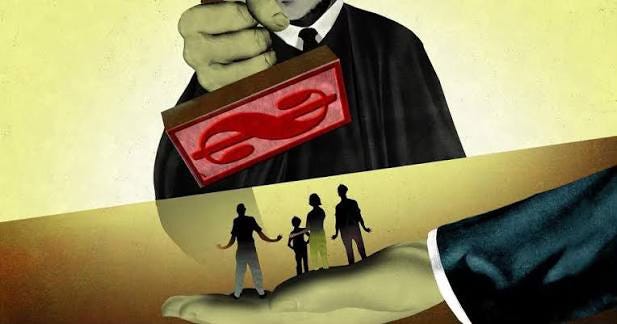
Every year, millions of people are subjected to the whims of an American civil court system that is, for the average American, labyrinthian and inaccessible. And, to the detriment of everyday people, restrictively constructed legal landscapes couple with rising financial precarity to push workers to face courts without support. Scales are tipped against workers in a mockery of justice as institutional players with legal expertise are pitted against individuals who experience the court system as a bewildering procession of unintelligible commands. Among low-income workers, 3 out of 4 will face at least one civil legal problem yearly, oftentimes with life-altering consequences connected to domestic abuse, housing, employment, or child custody. Middle-income workers living paycheck to paycheck will feel their lives unravel after one emergency expense and are forced to forgo the additional cost of a lawyer they can not afford. In the end, many are left financially crippled.
A short explanation of how we got here. During the Great Depression, traditional legal practices and bar associations faced a growing threat from Automobile Clubs who offered inexpensive legal representation to their members. After failing to lobby state legislatures into outlawing Auto Club legal practices, established legal institutions went after the clubs in institution-friendly courts. The ABA aggressively pursued Unauthorized Legal Practice (ULP) laws against the clubs and, despite a lack of evidence that the cheap legal services were harming consumers, justified their crusade with hollow calls for consumer protection and professional integrity. There is a place for ensuring effective, honest legal representation. There are real concerns surrounding legal malpractice gaps and unscrupulous actors who aim to take advantage of consumers. But in effect, the ABA fought to sacrifice the average person’s access to justice for the profit of incumbent lawyers. The ABA won in the courts, and we are suffering from it.
Today, overly restrictive ULP laws are employed to lock out potential legal service providers, hinder the adoption of legal technologies, and generally hurt the American people. Among the millions of Americans facing legal problems, 120 million of their legal issues will remain unresolved by year’s end. When reliable access to justice is far-fetched and fair resolutions seem impossible, the rule of law that underpins our democracy is at risk. For as long as we can not consistently provide for and protect people’s basic needs through legal means, then our country’s promise of equality before the law will remain unfulfilled. Since Covid-19, what legal commentators have for decades deemed an Access to Justice crisis has reached a fever pitch. Meanwhile, trust in the American judicial system has collapsed to record lows. And still, the country as a whole and the American Bar Association in particular fail to respond to the crisis. Which is not to say no action has been taken. For instance, New York City recently passed Right to Counsel (RTC) legislation for tenants in eviction cases, and other cities and states have since followed suit. As a result, more tenants stay in their homes, obtain repairs, and avoid illegal rent overcharges. This is not nearly enough. In NYC, evictions are on the rise, only 40% of RTC-eligible tenants receive the counsel they are entitled to, and the program does not even begin to cover most civil cases. Although we should heed calls to expand RTC programs, a myopic focus on more lawyers will not address the needs of tenants and workers. Coupled with expansive legislative and executive action, we need a more fundamental restructuring of our approach to civil justice.

Bluntly speaking, legal services for most Americans are either inaccessible or unaffordable. This situation is rooted in our past; it is not an inevitable part of our future. We can and we must choose to change it. Most people facing legal challenges do not need intensive legal intervention to take them through trial. Not every legal problem needs a lawyer, and, analogous to how a nurse practitioner might supplement a doctor, we can imagine a legal infrastructure that provides legal-lite services to address people’s concerns when lawyers are not necessary. Specialized government ombudsmen, tenant associations, community groups, or workers’ unions may organize to provide these legal-lite services, primarily oriented around furnishing legal advice and courtroom assistance, to deliver for those they represent in issues ranging from debt collection to eviction prevention to employment discrimination. Similar approaches are already implemented in other countries, and the FTC has recommended them here.
With the current pace of AI capabilities growth, we should seriously consider using these technologies for legal-lite type situations in the near future. Unfortunately, there is a significant risk that ULP laws will reflexively prohibit solutions oriented towards addressing public needs. Even before debate began around ULP regulations and Generative AI models, there were lawsuits against LegalZoom. LegalZoom offers interactive assistance with legal documents, including divorce papers, name changes, power of attorney, and wills, on behalf of its customers. Lawsuits have limited the scope of its application and imposed costs on the provision of its services. Admittedly, the motivations of the lawsuits against LegalZoom were mixed in their concern for the public interest. However, regardless of the reason behind the suits, they do not discount the need for its services or ULP reform. Rather than inhibiting technological innovation that provides cheap legal services, policy makers should craft solutions around the actual harms they want to avoid, such as privacy disclosures and limitations on arbitration clauses, and establish accountability standards for nonlawyers providing legal services.
Implementing these solutions would enable non-lawyers to resolve legal issues for American workers and consumers at an affordable rate. And it would free current public interest lawyers from their overwhelming case loads, empowering them to more thoroughly advocate for the needs of their clients.
Though fear, lethargy, and professional parochialism may hold us back, justice and the economic well-being of millions of people demand that we use the tools and solutions available to us. We can create a world where average people reliably address the perpetually leaky ceiling above their head, or the incessant fraudulent debt claims made against them, or the medical insurance issues they slog through. We can create a world where disputes are resolved fairly and consistently, and where justice is not a luxury good. To do so, we must embrace all the tools available to us and evaluate how we can effectively use them to serve the public interests. We must allow for organizations and services that affordably and reliably reach the needs of the people, not ban them. We must construct a legal system that is intelligible for all of its parishioners, not only its priests; that promotes the fair and deliberative practice of justice for all people, not only the select few.
.
