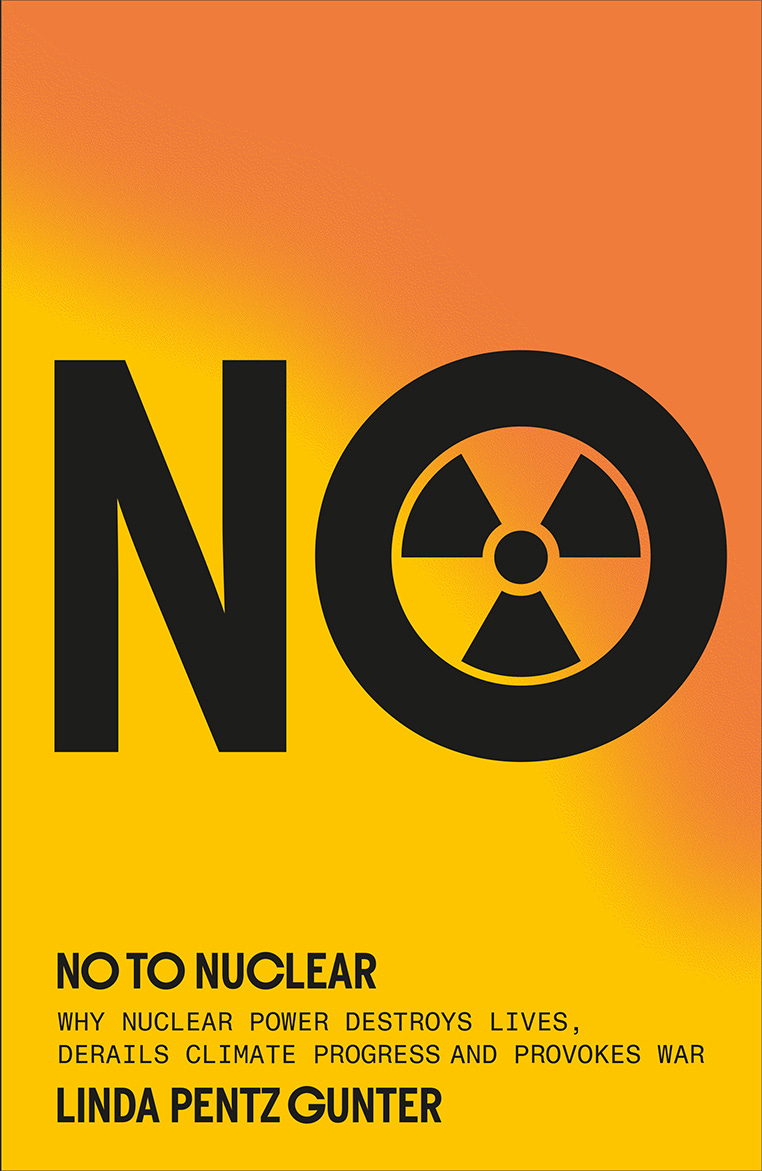
Though sections of the environmental movement have recently shied away from their historic anti-nuclearism, the position retains a small legion of adherents, with Linda Pentz Gunter—founder and international specialist of Beyond Nuclear, and author of the recently released No to Nuclear—among the most prominent in the United States. Her book “does not try to offer all the solutions,” instead opting to put “a human face on the nuclear story.” This is a fine and acceptable thing for a person to write. I see nothing wrong with cataloguing the human-level impact of nuclear power, or of any technological development, for that matter. I do, however, take issue with what follows: “It is hoped that this book will inspire a strong resolve in its readers to refuse to accept nuclear power as a climate solution,” a sweeping position that Gunter’s argument completely lacks the thrust to justify. Her disclaimer, that the book is not meant to be a technical policy work, reads like a cop-out when its thesis is an extremely bold policy claim: that we ought to completely abolish nuclear energy as a source of electricity. With apologies to Gunter, I must confess that I was not persuaded. Though I finished the book with, if nothing else, a better sense of the injustices faced by marginalized communities during nuclear energy’s complex history, the skipped logical steps and shoddy evidence throughout No to Nuclear left me far from convinced of its titular prescription.
No to Nuclear and books like it often find a small but influential audience among the activist left, and this one arrives with cover endorsements from Ralph Nader and Jeremy Corbyn. Given Nader’s and Corbyn’s political commitments, I’m hardly surprised by their positions on nuclear power, but that books like this circulate as widely as they do in the left-wing activist media diet feels like a problem. The book is not good. It preaches to the choir, cherry-picks evidence, and repeatedly and baselessly alleges ulterior motives among its ideological opponents. Left-wing political literature deserves better than this. If the only positive notices on the back of the book are from Ralph Nader, Kate Hudson (the former general secretary of the Campaign for Nuclear Disarmament, not the actress), and Jeremy Corbyn, then it probably hasn’t brought in anyone new, and that’s the best-case scenario. At worst, it has contributed to a culture of anti-intellectualism and bad faith among the people who ought to be as sharp and skilled at coalition-building as possible. In reviewing No to Nuclear, I hope to, in some small way, contribute to the opposite.
At its best, No to Nuclear serves as a thorough catalogue of the grave and forgotten injustices faced by our planet’s most destitute, and effectively brings to light some of nuclear history’s darker chapters. I think “please don’t dump waste in the Native American burial ground” is a perfectly legitimate ask, and we ought to be ashamed of having done this. However, what No to Nuclear omits is just as telling as what it highlights; Gunter repeatedly fails to explain why such crimes are either unique or inherent to the nuclear industry. Without those second and third steps, the argument is immature, and certainly doesn’t support a claim as radical as “nuclear power should never be used.” Several times, she brings up the Democratic Republic of the Congo, one of the world’s most exploited, downtrodden countries, and her discussion of it is illustrative of both the book’s primary strength and its most glaring weaknesses. The examples of abuses she provides are harrowing and ought to be considered in future mining policy. But there also exist uranium operations that leftists could look at without flinching: Cameco’s mines in Saskatchewan’s Athabasca Basin run a workforce that is roughly 46 percent Indigenous, are organized under the United Steelworkers, and operate under collaboration agreements with the First Nations whose land they sit on and under the scrutiny of the Canadian Nuclear Safety Commission. As leftists, we should not tolerate the conditions Gunter describes, but rather than ban the entire technology, we should strive to generalize the humane practices that already exist. No to Nuclear does not explain why this cannot be done. What’s more, the Congo is arguably just as infamous for its cobalt mining, a critical industry in certain renewables, as it is for its uranium mining. While solar panels themselves do not require cobalt, the broader renewable energy ecosystem—particularly battery storage—depends on supply chains that raise ethical concernssimilar to those raised with respect to uranium mining. Omitting this is, charitably, a massive oversight, and less charitably, an act of dishonesty. Gunter is quick not only to decry the injustices within the extractive side of the nuclear industry, but also to accuse its proponents of intentionally downplaying them. But it’s hard for me to see how she’s not doing the same if she’s willing to polemicize the Congolese uranium mining industry without even sparing a mention for similar brutality in cobalt extraction.
No to Nuclear’s arguments usually proceed as follows: the book presents a nuclear-related grievance, such as a historical injustice against a marginalized community, an instance of corruption, or a failure in political transparency. It then, usually after omitting necessary context, attempts to pre-empt any pro-nuclear rebuttal by characterizing the response of the industry or of nuclear advocates as dishonest, insufficient, or even malicious. To advance these claims, Gunter will usually next attack the character of her ideological opponents, whose disagreement with her position can, it seems, only be accounted for by some sort of corrupt bargain with the industry. In chapter 2, evocatively titled “Nuclear Injustice,” she asserts, without evidence, that George Monbiot—a committed, lifelong environmentalist who won the UN Environment Programme’s Global 500 award in 1995—was “recruited” by the nuclear industry to downplay the lasting effects of the Fukushima disaster, the eventual scale of which, she writes, “time will tell.” Gunter’s claim that the potential health outcomes of the disaster warrant further study is one that almost nobody on earth, including nuclear advocates, would dispute. If the title of this book were “Someone Should Look Into This,” claims like this, which are somewhat supported by the literature on radiation exposure, would hold a little more weight. But the title of the book is “No to Nuclear,” a sweeping and absolute policy prescription. It certainly needs more support than “the most high-profile nuclear disaster of the 21st century might be responsible for non-lethal health issues at some point in the future.”
Gunter’s penchant for making corruption allegations against her ideological opponents gets very exhausting very fast. To be clear: I take no issue with Gunter’s tonal combativeness. I am no stranger to this register myself. But the frequency and baselessness of Gunter’s allegations of wrongdoing are not just a matter of writing style, but of persuasive substance; many of her arguments hinge on falsely villainizing her opponents. The “recruited” allegation she levies against Monbiot, for instance, is exactly the sort of unevidenced accusation of paid influence that UK defamation law takes seriously, and both Monbiot and Gunter’s publisher are based there. To illustrate the pattern, I flipped to a random page to see if I couldn’t find some conspiratorial smear against someone with the gall to disagree with her. I didn’t even have to turn the page before I landed on such an attack against one Oliver Stone. According to Gunter, Oliver “JFK was a coup d’état” Stone, quite possibly the most dissident, conspiracy-minded figure in American cinema, is the nuclear industry’s “newly anointed—but poorly chosen—attack dog.” If she has any evidence for this “anointment,” she doesn’t provide it in the book. In the same breath, she calls him a “self-appointed nuclear power expert.” So which is it? Is he a paid operative or a lone wolf? Gunter is so addicted to insulting people that she can’t even keep her insults straight. She doesn’t even elaborate; the rest of the section is a rant about how Stone’s 2023 documentary Nuclear Now did poorly at the box office and was worse than Oppenheimer. I liked Oppenheimer too, but I’m at a loss as to what that has to do with the thesis, or with whether Oliver Stone is bought-and-paid-for. We should decide on all policy this way.
Returning to Fukushima, she later attempts to offer some evidence on the aftereffects of the disaster, but her citation choices exemplify her—we’ll say complicated—relationship with correlation and causation. She writes: “Researchers in Japan found a detectable excess in thyroid cancer within four years after the Fukushima disaster. But Japanese authorities insist there is no correlation between the two.” When I first read this, I expected to read at least someargument as to why the Japanese authorities in question are untrustworthy. None came; the task of negatively characterizing these faceless bureaucrats and white coats seemed mostly left to the reader. Gunter is coy here because being direct would undermine her insinuation. Thyroid cancer increases in Fukushima are thoroughly documented, but the research broadly does not support a causal relationship between the disaster and subsequent diagnoses. For one, the timeline doesn’t add up. According to the research conducted on the aftermath of the Chernobyl disaster, radiation-induced thyroid cancer typically emerges four to five years after initial exposure, and in Fukushima, the spike in cases took place before the three-year mark (Gunter’s use of “within four” is doing a lot of heavy lifting here). The literature’s prevailing conclusion attributes this increase predominantly to screening effects: Fukushima saw a spike in cases after an understandable surge in cancer screenings among the local population. Thyroid cancer is notorious for turning up in large numbers of people whose tumors would usually never have posed a significant health problem, which would increase the magnitude of a screening effect; people who would have otherwise gone about their full lifespans harmlessly unaware of their benign thyroid tumors suddenly had reason to screen for and detect them.
This is not the only time Gunter, in the absence of well-established evidence, indulges her proclivity for conjecture. She also discusses the case of Pike County, Ohio, in which a spike in health issues, including cancer, among the population correlates with the activity of a local nuclear facility. It is worth being precise about what that facility is, since Gunter is not: the Portsmouth Gaseous Diffusion Plant at Piketon is a Cold War uranium enrichment site that fed the American weapons complex and never hosted a power reactor at all. That distinction matters for a book whose thesis is that we should stop generating electricity from fission. Gunter cites multiple instances of authorities contradicting a causal hypothesis, with one agency claiming “that the levels of radioactivity detected in Pike County are ‘too low’ to be responsible for the high rates of cancers and other illness the residents blame on the plant,” and a study that “decided there was no correlation.” Once again, Gunter stops short of directly accusing the researchers of corruption, which is very clever of her. But mentioning these studies within a chapter titled “Nuclear Injustice” is a transparent impeachment. Gunter can’t polemicize these studies outright because she doesn’t actually engage with them on the merits. She neither substantively critiques their methodology nor provides evidence supporting her allegations. Once again, the reader is left to fill the gap and conclude that these scientists must be negligent or malicious. Absent substantiation, this is question-begging, putting would-be detractors in the unenviable position of appearing to question people’s “lived experiences.” But if that’s the route we’re going to go, then we need the full story. Pike County does indeed have an elevated cancer rate, but it is also among the poorest counties in the state of Ohio, which Gunter herself states. The obesity rate is well above the national average. The same is true of the smoking rate. Residents of the county face barriers to healthcare access not faced by the average American. These determinants are well established contributors to high rates of cancer. It’s possible that radiation from the site contributes to cancers, and any suspected link ought to be studied. But to make such a claim, even disregarding the obvious confounding variables I listed above, requires study and evidence. Gunter’s habit of cherry-picking the research she likes and smearing that which contradicts her views doesn’t do her credibility any favors, and may or may not reveal an ulterior motive of her own. Just kidding; I made that up. See how easy it is?
No to Nuclear’s emotional arguments are also consistently plagued by Gunter’s allergy to context, which makes a lot of the writing feel dishonest. I have nothing against pathos in works like this. Even I, a strong advocate of nuclear energy, see a lot of value in transparency about the darker aspects of the industry and its history. Honesty is good for public relations, but that aside, pro-nuclear leftists should emphasize strong oversight and caution on principle. There are legitimately dangerous aspects of this technology, and it’s only through diligent research and thorough safeguards that we’ve managed to mostly avert disaster. But frontloading harrowing imagery without providing an honest sense of the scale at play, nor a fair look at how safety concerns have been addressed, can hardly be considered transparency. Chapter 3, “Animals and Ecosystems,” is illustrative here. Gunter’s first example is so on-base for an environmentalist it’s almost cliché: nuclear power threatens the lives of the turtles, and therefore must be scrapped. No one wants to look like a turtle clubber, but I see no point in pretending that this doesn’t occur. Some nuclear cooling systems suck in aquatic life in a process known as entrainment, sometimes resulting in the animal’s death. No to Nuclear describes this in vivid detail, and makes sure to take a jab at the regulators who, in the case of the St. Lucie power plant, found that the degree of environmental harm was acceptable with certain mitigating responses. Gunter, true to form, alleges, without evidence, that the Nuclear Regulatory Commission is “captured.” Researchers also observed another facility that was massively disrupting salmon migration patterns, with severe knock-on effects for the surrounding ecosystem. Even then, regulators decided that, after a few tweaks to their spill practices and increased funding for habitat restoration, the plant could continue operating. Messed up, right? Except that the facility in question isn’t a nuclear power plant at all; it’s the Bonneville hydroelectric dam, whose impact on salmon dwarfs the St. Lucie plant’s effect on sea turtles in scale. Regulators do not apply a zero-harm standard to any form of power generation. To cite an instance in which they deemed a project to cause acceptable harm as evidence that nuclear power gets special treatment is absurd on its face; regulators make decisions like that every day, and with regard to energy sources other than nuclear power. They are not in themselves evidence of “capture.”
I abstain from eating meat on ethical grounds. I do not enjoy saying things like “Sometimes a development is going to kill a few turtles,” but it’s true, and not only of nuclear power plants! I don’t know where people got the idea that renewables, in contrast to nuclear power, exist in isolation from the ecosystem and can be built with zero harm to the environment, but it’s just not true, likely will never be true, and would result in a halt to all building if applied as a consistent regulatory standard. If Gunter has an issue with how MANY turtles are killed, or wants to substantively argue that our threshold for acceptable harm is too high, with scientific evidence as to why, I would be happy to engage. But there just isn’t much there, probably because such an argument would contradict the idea that nuclear power is uniquely harmful or receives special treatment. But Gunter is so fixated upon opposing nuclear energy on a technological level that her nascent points about developmental impact and oversight have no room to breathe.
I’m probably going to be called “captured” for saying this, but the industry really is trying to address many of the issues that No to Nuclear raises. However, Gunter cannot for the life of her take yes for an answer. She refers to the matter of radioactive waste as a problem that the nuclear industry would “rather run away from than solve.” Shortly thereafter, she proceeds to list several examples of attempts the industry has made to solve the problem, which struck me as somewhat self-undermining. One such attempt, Finland’s new nuclear waste repository, Onkalo, has thus far seen such unproblematic planning and execution that Gunter has to make misleading statements in order to castigate it, suggesting that nuclear waste remains “lethal effectively forever” and that Onkalo’s 100,000-year storage longevity is “far less time than the duration of its long-lived radioactive cargo.” To support this framing, she cites examples of long half-life byproducts, including uranium-238. The radioactivity of spent cores can endure for hundreds of thousands, even millions, of years, but “radioactive” is not interchangeable with “lethal,” nor with “anthropogenic.” Bringing up U-238’s half-life in the context of Onkalo’s projected longevity is absurd, because, as Gunter neglects to mention, uranium-238 occurs naturally! An isotope with a glacial half-life also has glacial radioactivity; that is the same fact stated twice. I certainly wouldn’t recommend EATING uranium-238, but sharing a planet with it won’t kill us—we do that already! 100,000 years is ample time for spent fuel to get through its most dangerous phase. Applying Gunter’s zero-tolerance safety standards vis-à-vis radioactivity would require us to build a Death Star and blow up the planet. She also mentions that Onkalo will contain “the output of Finland’s own reactors but no others,” leaving “the rest of the world struggling for answers.” So the worst thing Gunter can say about facilities like Onkalo is that there aren’t enough of them. Facts.
Just as glaring as Gunter’s omission of critical context like this is her unwillingness to discuss scale, basically at all. Even after all the smears and cut corners, I was sure that she would at least address the central pillar of nuclear advocacy: that, in spite of the high-profile nature of its infrequent failures, nuclear energy boasts one of the lowest rates of death per terawatt-hour of all energy sources, comparable within the margin of error to solar and wind power, and orders of magnitude safer than fossil fuels. At the very least, I thought I might find some sort of baseless corruption allegation against the researchers who dared to observe evidence supporting a pro-nuclear view, but the numbers are just not addressed at all. I understand that the book is not meant to be a technical treatise, but that doesn’t matter if its central claim requires technical analysis to support it! You can’t just disclaim your way out of a Swiss cheese thesis. No to Nuclear is a qualitative, critical look at the nuclear industry’s history, and again, there is nothing inherently wrong with that. But you don’t get to explain away your lack of technical scrutiny with one side of your mouth and make extraordinary, groundless technical prescriptions with the other.
Omitting critical quantitative detail isn’t just argumentatively shallow; it’s irresponsible. Gunter also fails to engage with the large body of literature suggesting that nuclear phaseouts result in an increase in fossil fuel usage. In the United States, the closure of the San Onofre Nuclear Generating Station, which had supplied roughly a tenth of California’s electricity, was replaced almost entirely by fossil fuels in the short term, producing a 35 percent increase in gas generation against a 33 percent decrease in clean generation, and an extra 37 million metric tons of CO2e over the four years it took the state’s power sector emissions to climb back down. Japan’s closure of nearly all of its nuclear plants following the Fukushima disaster resulted in a massive increase in natural gas importation and a huge spike in coal and oil generation. Germany’s nuclear phase-out also resulted in an uptick in fossil fuels to fill the vacuum. It’s true that Germany’s emissions decreased over this period, but the most recent synthetic-control analysis finds they decreased more slowly than they would have without the phase-out, and that it took until 2023—twelve years of renewable buildout—for the gap to close. Twelve years of avoidable fossil generation is not a rounding error. In fairness, it’s not like Gunter is big on fossil fuels either. Her list of approved energy sources includes “Solar power plants, photovoltaics,… wind power, geothermal heat and electricity, tidal and wave power,” which are good because they are found “In nature,” unlike naturally occurring uranium, which doesn’t count. But a process as catastrophic as climate change demands a results-oriented approach, not a deontological one, and nuclear phaseouts consistently result in an increase in carbon emissions. Some environmentalists will never be convinced to love nuclear power. But I hope they can at least be convinced not to demand reforms that would unintentionally jeopardize the future of our planet.
I thought No to Nuclear’s arguments would improve once it stopped discussing nuclear power and started discussing nuclear weapons. The view that the two are inexorably linked is misguided, but that aside, I agree completely with the movement’s views on the weapons; they should not be built, let alone used, and their proliferation has been an unqualified disaster for global stability and ecosystem health. But even though I actually align with Gunter more on nukes, I still couldn’t find much compelling about her arguments. Her intellectual hygiene doesn’t improve alongside the defensibility of her stated position. She resorts to the same smears, the same shortcuts, the same factual errors, and even ends up carrying water for war hawks, blaming the June 2025 US and Israeli strikes against Iran on… Iran’s civilian nuclear program? She states of the bombings: “This happened precisely because a nuclear power program provides the opportunity to develop nuclear weapons,” and that “Iran’s possession of a civil nuclear power program alone rendered it vulnerable to attack,” assertions that belong in a belligerent, neoconservative screed of the Project for a New American Century vintage. The implications of this claim are deeply troubling; if America’s geopolitical opponents’ nuclear programs are to blame for American intervention against them, it would follow logically that such countries are obligated to dismantle their programs out of terror. The whole line of argument falls flat anyway when Gunter suggests that the nuclear threat is “a pretext for an attempt at regime change,” in which case the administration would have found some other casus belli anyway! For Gunter to sit there and blame the war on Iranian civilian infrastructure, much of which has been destroyed by the US and Israel, is utterly tone-deaf. She is not obligated to address the entire left-wing omnicause in her book, but if all she wanted to accomplish in bringing up this tragedy was to cynically push her own anti-nuclearism, then she should not have done so at all.
It’s no secret that Iran has recently increased its enrichment levels, but, as Gunter herself states, this only resumed following President Trump’s withdrawal from the Obama administration’s landmark nuclear deal, the Joint Comprehensive Plan of Action, in May 2018. Until then, Iran abided by the JCPOA’s enrichment limits, as the International Atomic Energy Agency repeatedly verified. No to Nuclear would have its readers believe that weapons proliferation is inherent to nuclear power, and cites several examples of civilian to military nuclear transitions from a time when fewer safeguards were in place and verification mechanisms were less robust. But since then, the JCPOA has told us a different story: whether we prevent further proliferation is a policy choice, and it’s one we can make without casting aside nuclear energy.
But perhaps most infuriating of all is Gunter’s outright dismissal of controlled fusion as a power source, her writing about which exemplifies everything wrong with the environmental movement today—its parochialism, its cynicism, its undying antipathy toward anything it deems insufficiently cottagecore. The possibility of controlled fusion should bring us all together, no pun intended. Why? Because if it works, that’s it. No emissions from fossil fuels, no waste from fission, and no electricity shortfalls from getting rid of one or both of these. Picture a world where our grandchildren mock us from the backseats of our flying cars for ever doing anything else for electricity as we roll our eyes and smile knowingly, where everyone on all sides of the energy debate can have their cake and eat it too. And Gunter says no. Can’t be done. Pack it in, eggheads. She superficially engages with the science, but her objection isn’t really technical. She downplays the 2022 and 2024 breakthroughs in fusion by saying that the net energy output of the experiments themselves wasn’t enough to power anything, and that the laser used to trigger the reaction used more energy than was generated. She is right about the second part, in the narrow sense that the National Ignition Facility pulls hundreds of megajoules off the grid to deliver about two megajoules to a target, and she is wrong about why it matters. In December 2022, 2.05 megajoules of laser energy produced 3.15 megajoules of fusion energy; in February 2024, the same facility got 5.2 megajoules out, better than twice what went in. How philistine can you get? The point wasn’t to power anything; it was to demonstrate the underlying physics! Does Gunter think the first solar panel was commercially viable? For someone who loves renewables so much, she has very little regard for the scientific process by which they were developed. She also states that a viable fusion reactor would be obsolete anyway because “if we are still here, we will have done the right and only thing and moved away from large, centralized sources of energy to smaller, far cheaper and decentralized renewable energy and energy efficiency.” I don’t even know what to say to this. Is refusing to use a massive, clean source of electricity somehow energy efficient? I thought Gunter opposed nuclear power on environmentalist and humanitarian grounds. What does the organizational structure of the power sources have to do with this? Even if Gunter’s prediction came to pass, and the electrical grid was 100% renewable within a few decades, we would still have plenty of need for fusion. But no, it’s the wrong kind of facility, with the wrong kind of organization. This is puritanism; her moral strictures against what she deems excessive or decadent supersede any actual cost-benefit analysis. In rooting against fusion, No to Nuclear roots against both the ecosystem and humanity.
No to Nuclear is a self-professed knife in a gunfight. The debate Gunter attempts to settle in writing the book demands a lot more technical rigor than she actually provides. The fundamental conceit underneath the book, as revealed by the fact that it omits these things, is that evidence and a sense of scale are unnecessary to answer these questions. Gunter discusses deaths caused by nuclear power… relative to nothing. She asserts that we have no use for its electricity… without discussing global electricity demand. And worst of all, she compensates for this by baselessly smearing researchers and commentators who DO discuss these things. Because I refuse to stoop to this, I want to end on a positive note and reiterate that Gunter engages in some genuinely important historical documentation of often forgotten communities. I think advocates of nuclear power should consider and uplift such perspectives, so that we might repair our relationship with those most affected by the industry’s missteps and avoid them in the future. But No to Nuclear does not demonstrate that we need to entirely abolish nuclear power in order to accomplish this. As we all must be, I am always open to evidence to the contrary, but until I see it, I’m going to stop worrying and love the reactor.