


While supply-side reforms and universal welfare are falsely posed as antithetical to each other, Cuba breaks this narrative, delivering universal healthcare with only one fourth the GDP per capita through the production of 2.5x as many doctors per capita. Providing fast and affordable medical education while breaking regulatory bottlenecks on our supply of doctors will help deliver Medicare for All.
Supply-side advocates provide a set of critiques against the bloated cost of the American health system, and they blame regulatory capture. American Medical Association (AMA) lobbying has historically capped the funding of residency slots, restricting the supply of doctors to keep salaries high. The high cost of a medical education burdens doctors with large amounts of debt, incentivizing new doctors into high-paying specialties instead of the widely needed practice of family medicine. Worse yet, state-by-state licensing legally restricts physicians from moving to where they are most needed. This short-supply of doctors is paired with artificially increased demand caused by AMA-supported scope-of-practice legislation that restricts nurses from performing the actions of doctors in many states—depressing the wages of nurses.
The same line of critique extends to other areas of the healthcare system, and you get the same conclusion: the American healthcare system is deeply inefficient, resulting in higher costs, longer wait times, and worse patient outcomes. If we want to provide Medicare for All at an affordable price, supply-side policies that reduce costs are useful tools for socialists to keep in their back pocket.
This is not a hypothetical, governments that provide universal healthcare have already internalized these critiques to provide universal health care cheaply; see Cuba. While Cuba is much less wealthy than the US, the promise of universal healthcare is enshrined into their constitution. To deliver that promise despite such scarcity, the Cuban medical system has learned to deliver clinical abundance at low cost.
The Cuban Model
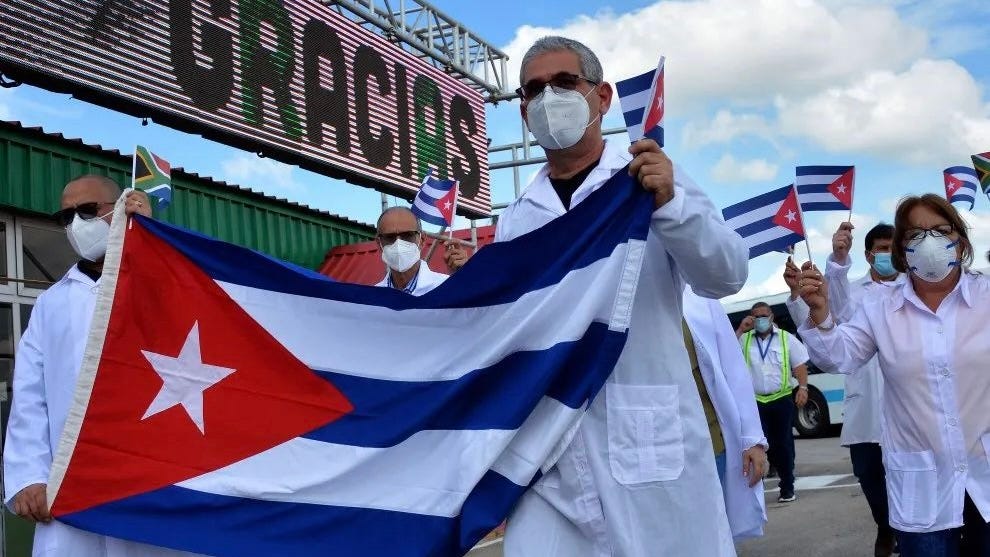
Cuban Medical schools admit doctors and nurses out of secondary school and take 6 years to complete. With free tuition and guaranteed placement, the state funnels a large amount of talent down this pipeline. After medical school, doctors are deployed either domestically or abroad to pay back the state. While doctors have little autonomy over placement–in contrast to the limited residency slots that bottlenecks US training volume and the medical debt that forces doctors into high-paying specialties–this process deploys more trained doctors in less time to places where medical professionals are needed.
While the AMA and nurse practitioner lobbies fight over scope-of-practice regulations that vary by state, Cuban scope-of-practice is defined uniformly by bureaucrat fiat based on academic research on a federal level—as is Cuban licensing. Cuban law does prevent nurses from prescribing medication–giving doctors more leverage over nurses than some American RNs. However, this could be changed on the federal level rather than through a patchwork of state-by-state lobbying.
For its limited material resources, Cuban healthcare is surprisingly effective. While doctors are in supply, Cuba does not have enough medical equipment to go around—largely due to the 64 year-long American embargo that has been condemned by the UN for over thirty years. Gold-standard US-patented pharmaceuticals and medical technologies are practically out of the question. Yet, in the face of such constraints, life expectancy remains comparable to the US, infant mortality is even lower, and Cuba has become the first Latin American country to eliminate mother-to-child HIV/syphilis transmission. What the US achieves by spending $15,000 per person, Cuba achieves by spending $1000 per person. While the US frames supply-side restrictions in the language of safety, the efficacy of the Cuban model reveals that we could provide much better care by adopting Cuba’s training volume.
Yet this model is under severe strain. Between 2021 and 2022, Cuba lost over 12,000 doctors, 7,400 nurses, and 3,000 dentists—driven out by monthly wages of $40-70. Many healthcare workers pivot into the tourism sector, where tips from foreign visitors outpay a medical degree. Rather than raise wages or improve conditions of medical workers, the state reimposed travel permits on doctors, restricting their freedom to leave the country. Cuba’s model, buckling under insufficient worker compensation, excessive state extraction of labor value, and material scarcity still produces population health outcomes that rival the wealthiest country on earth—which reveals how much the American system leaves on the table through its own set of regulatory inefficiencies.
Ultimately, it is the US that controls two of the largest supply constraints on Cuban healthcare: the embargo of material inputs and international credentialing barriers that restrict the output of labor. Just as it is incumbent on the US to remove restrictions on our own supply, it is necessary for the American government to end the embargo to provide Cuban patients the equipment they need. Furthermore, IMG credentialing barriers force any doctor trained outside of the US to repeat 3-7 years of residency to practice here. Not only do doctors from outside the US make healthcare cheaper, but they are also more likely to practice in underserved areas. Reforming IMG credentialing would allow Cuban doctors who seek to practice in the US to do so. To engage in isolationism, tariffs, and embargo is against a material internationalism that seeks to develop productive capacity across borders rather than hoarding it behind them.
As is evident in the case of Cuba, supply-side reform is not fundamentally neoliberal. Providing an abundance of public services like healthcare is a historical and future aspiration for socialist governance. What would it look like to adopt Cuba’s training volume and primary care orientation without its coercion? Free or subsidized medical schools would remove the debt barrier that both filters candidates and incentivizes high-paying specialties instead of family medicine. Lifting the residency cap—which the AMA itself now supports—would unclog the bottleneck that has artificially constrained the number of practicing physicians since 1997. Federal licensing and scope-of-practice standards would eliminate the state-by-state patchwork that restricts where doctors can practice and what nurses can do. Loosening credentialing barriers for international medical graduates would tap a supply of trained doctors that the current system squanders. These proposals merely require the recognition that clinical abundance is a policy choice, and that the scarcity built into the American system is not an inevitable feature of high-quality care but an artifact of regulatory capture that serves incumbent professionals at the expense of patients.

This is a quality piece. However, frankly, it's irresponsible for a socialist writer not to mention the current oil embargo choking Cuba's economy – unprecedented and qualitatively different from the 64-year embargo.