

Blood Boy for All
Young blood is a human right

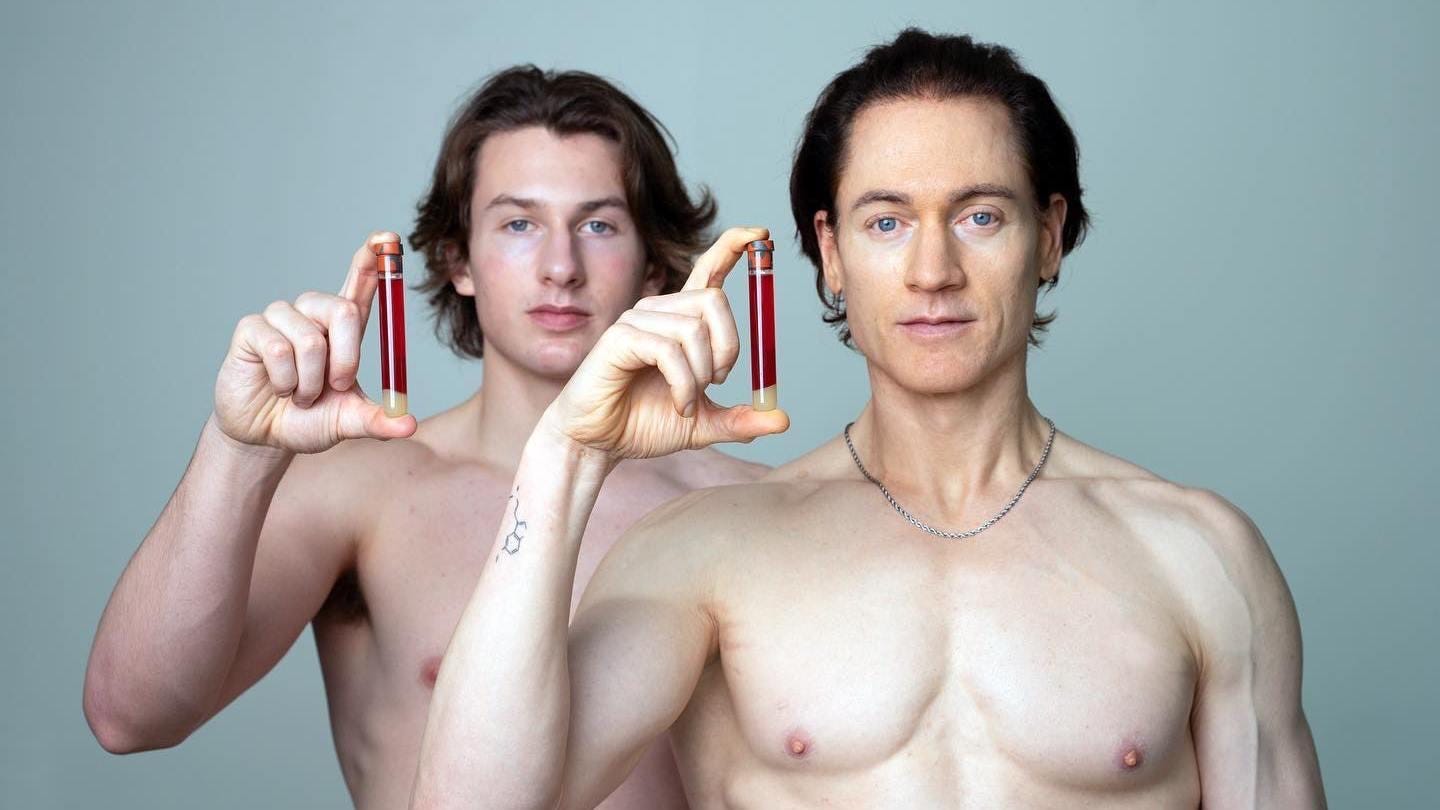
Isn’t this photo incredible? Above: the man who made Venmo profitable, Bryan Johnson, posing shirtless with his teenage son. They hold vials of each other’s plasma as a photoshoot for Project Blueprint. Three generations of Johnson men engaged in a series of young-to-old plasma transfusions under the premise that young blood could slow or even reverse the effects of age. The goal? Don’t Die.
From what I can tell, no one was a huge fan of this act of literal vampirism from an incredibly wealthy venture capitalist. While I don’t think the shirtless photoshoot did them any favors, the substance of this endeavor was roundly clowned on when Bryan Johnson cased treatment, citing lack of revealed efficacy.
So, that’s it then. The uber-wealthy continue to fantasize about immortality, satisfying this urge with science-fiction treatments. The emperor eats mercury to live forever…
However, to be honest with you, it is entirely plausible injecting young blood could make you younger.
Bryan Johnson’s Project Blueprint isn’t an insane fantasy, it’s a disgrace to the positive-sum and egalitarian goals of scientific research. While Johnson has burned millions of dollars running irreproducible studies on himself, dozens of scientists have studied the rejuvenating impact of young blood—not for the immortality of one CEO—but for the health of the public.
There’s Power In the Blood

There is pow’r, pow’r, wonder-working pow’r
In the blood of the Lamb;
There is pow’r, pow’r, wonder-working pow’r
In the precious blood of the Lamb.
--“There is Power in the Blood,” Lewis E. Jones, 1899
Johnson’s infusions were inspired by studies examining the effect of connecting the circulatory systems of young and old mice. This technique called heterochronic parabiosis has shown rapid, coordinated improvements across organs: muscle regeneration, neurogenesis, and lower inflammation. Something about injecting young blood into old mice can bring back signs of youth throughout the entire body.
Naturally, human studies followed. Early attempts found that infusing young-plasma was generally safe, but not necessarily effective. However, as of 2022, we’ve discovered young-plasma can induce changes in the expression of proteins and genetic regulation associated with aging and decrease inflammation in humans.
I understand how an industrious capitalist like Johnson might see this and say, I’ve seen enough. I’ve found a minimal viable product: my son! Whip together a couple of biomedical PhDs with some computer geeks and an FDA whisperer to make an app that matches wealthy consumers with their biomarker-optimized Blood Boy for whatever fortune that would cost. Throw in an at-home infusion kit so any aspiring Abraham can start injecting his son’s plasma.
There are hundreds of biotech startups that are essentially Blood Boy apps: less obviously vampiric but just as impractical. When running his at-home experiment, Johnson used an assay from TruDiagnostic, a company that offers regular blood testing for dozens of longevity biomarkers at $1,799 per year. Not only is this unreasonably costly, but also, as a biologist, I don’t know what I’d even do with the results of this test. First, these biomarkers are entirely correlative. Second, we already know the best ways to slow aging: eat healthy, exercise, sleep well, etc. Products like these do nothing to make a long life accessible to the public.
Thinking like a VC isn’t going to democratize public health. Thinking like a scientist might. Instead of stopping at the minimum viable product, basic science that uncovers the circulatory mechanisms of aging can provide actionable and affordable therapeutics.
Let us try to understand why those parabiosis studies worked in the first place. Even if plasma transfusions had obvious anti-aging effects in humans, it is likely that there are specific molecules in the blood that mediate these effects. This would be great, because then we could learn how to synthesize those molecules at scale and provide cost-effective treatment without straining our already limited supply of donated plasma. These molecules could take one of two forms:
Young blood has youth-inducing factors that cause rejuvenating effects
Old blood has age-inducing factors that, when diluted, reduce the signs of aging
As it turns out, just diluting aged blood causes many of the positive effects we see from heterochronic parabiosis in mice. This does not exclude the possibility of youth factors, but it does provide a new model for our problem: age is a plausibly reversible state that must be maintained by circulating biochemical signals. Johnson’s study could have revealed something novel about this if, when removing 600mL of his father’s plasma, he did not also inject 1L of his own plasma, replicating an experimental error the scientific literature had identified years prior.
Of course, Project Blueprint is not about discovering general principles of anti-aging that could benefit all people. It is about discovering what temperature sauna stimulates the production of heat shock proteins for Bryan Johnson. It is about compiling years of continuous glucose monitoring data where the title of every table is “Bryan Johnson.” It is about building an entire body of scientific literature on how to live forever, but only for Bryan Johnson.
Johnson’s supplement marketplace and NLRB cases are, I am assured, unrelated to the errors of his scientific method.
Thankfully, clinical trials are rigorously investigating promising plasma-based treatments for age-related diseases. For Alzheimer’s Disease, which affects over 7 million Americans, replacement of a single relevant protein in plasma, albumin, has shown promise in reducing clinical decline. Plasma factors have also been isolated for testing in Parkinson’s treatment, which affects nearly 1 million Americans. Scientific research on a topic as seemingly insane as the Blood Boy could lead to life-changing treatment for millions of people.
I don’t blame Bryan for wanting to conquer death—I just want to conquer death for everybody. I understand why people are so skeptical of real change to the human life cycle; most people can barely afford the medical treatment we have already. When we restrict the fruits of biomedical research to the wealthiest of our society, we create incentives for researchers to develop expensive consumer treatments that fail to improve public health. If we want a society that values scientific progress, scientific progress must be shared. I demand a Blood Boy for all.
There is pow’r there is pow’r in a band of workingmen,
When they stand hand in hand,
That’s a pow’r, that’s a pow’r
That must rule in every land—
One Industrial Union Grand.
--“There is Power in a Union,” Joe Hill, 1913

Photo Credits: Bryan Johnson’s Twitter & Vice’s Instagram
 | A guest post by
|