After Super Bowl LX’s culture war debacle, it’s hard to fathom a time when it was the left warring against flyover America’s historic pastime, but indeed, such was the dynamic. Its most major political debate though, was not whether Bad Bunny or Taylor Swift or Kendrick Lamar were too woke, but whether public funding ought to be used to build stadiums for private sports teams, with liberals, far too erudite and high-class for ‘le sportsball’, taking the con position. This was, at least, a debate about governance, and I would take this kind of politics in sports over the kind where half the country pretends to like Kid Rock in a heartbeat. I would like to revive this debate; it remains politically relevant and the culture war is frankly getting old. However, I will not be taking the traditional liberal position, that private ventures like athletic clubs always ought to fend for themselves. Some (though by no means all) athletic developments are beneficial enough to the economic health of their constituent municipalities that public funding for such ventures is not only justifiable, but essential. However, to proceed, we must develop an understanding of what makes the good ones good and the bad ones bad.
What not to do:
I am keenly aware that the “economic boon” argument for stadium funding is not a novel refrain, and has been used in bad faith to promote projects that ultimately don’t make much of a positive impact. For instance, Truist Park in Cobb County, Georgia, home of the Atlanta Braves, should not have received a dime of taxpayer dollars, at least, not without serious reworking. Then called Suntrust Park, the stadium was widely touted for its potential financial benefits to the county, and used $397 million of public money to build it over substantial (though not majority) local opposition. Since, Cobb County has faced a 14-15 million dollar annual loss on the development. This is partially because sports stadiums do not necessarily contribute new economic activity. Often, their revenue comes from consumers who previously spent their money on other forms of entertainment, suggesting that an activity “shift” is often more likely than economic growth. To combat this, Cobb County OK’ed the construction of The Battery Atlanta, a larger entertainment district surrounding the stadium, for which they also took losses; economic activity simply migrated there from other parts of the county, and growth and development surrounding the district were limited.

Sports stadiums are sites of economic activity. This does not make every venture capable of generating growth, and municipalities should not fund developments that do not contribute to growth. However, Truist Park’s initial failures did not occur simply because it was a publicly funded stadium; specific hallmarks of bad development contributed to its economic downfall. For one, the developers parked it 10 miles northwest of downtown Atlanta, a ridiculous distance that all but ensured economic activity in The Battery would be confined to Cobb County residents driving there, watching the game, and leaving. No retail or housing related growth took place, because why would it? The development didn’t revitalize a neighborhood, substantially increase property values, or integrate with other engines of economic activity in Atlanta. This exemplifies the larger problems with urban sprawl, i.e., how it wastes resources on developments that do not increase the likelihood of economic “encounters.”
It is worth noting, however, that Truist Park has seen some success in the last few years; the development no longer incurs a loss, and, for the first time, has been able to finance its own debt service, easing the fiscal burden on taxpayers. Even flawed developments such as The Battery can eventually break even. However, this should not be seen as a reason to develop thoughtlessly. When a government calls upon its citizens to fund a private venture, a decade of 8-figure financial loss is not excusable, but more importantly, it is not unavoidable.
What has worked:
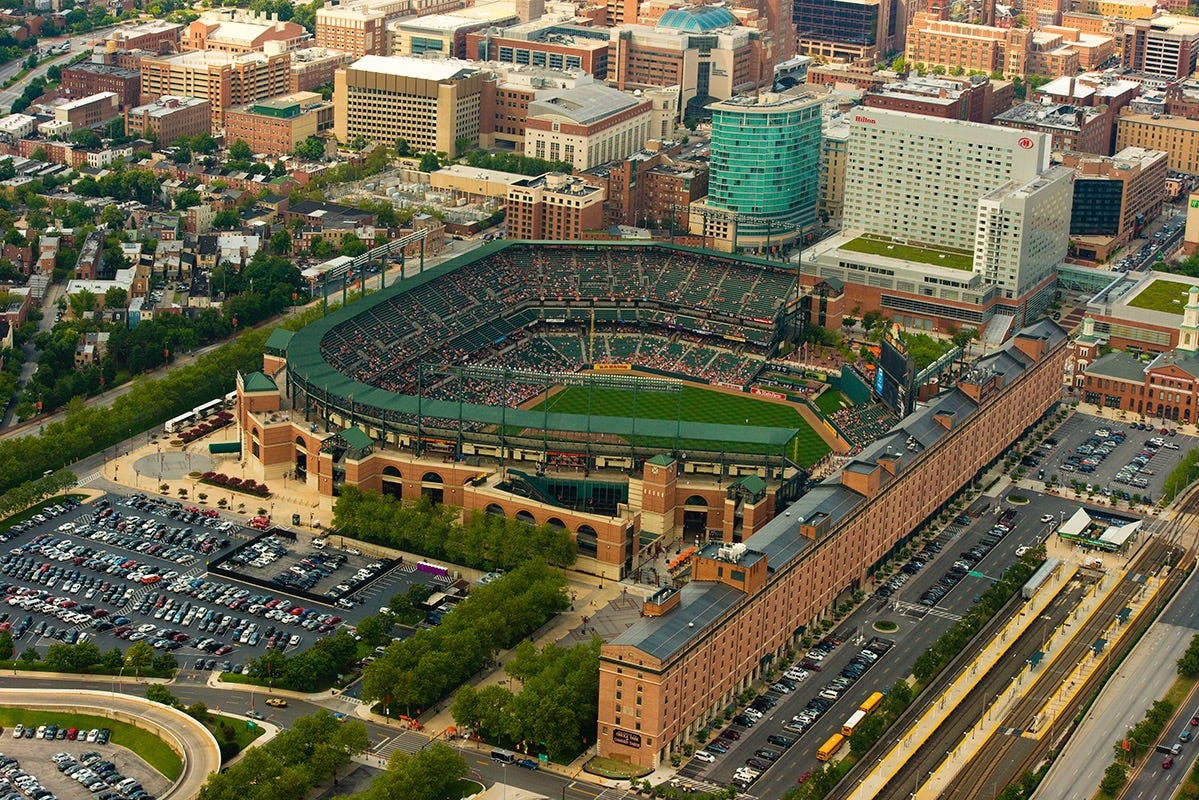
There is in fact a way to do this properly. Athletic stadiums are not inherently money sinks, and the failure of developments like Truist Park occurred thanks to particular flaws in the plan, e.g., its location and its failure to interact positively with existing economic fixtures. For every Truist Park, there is a Lambeau Field in Green Bay, or The Banks in Cincinnati. One of the most inspiring success stories is the home of the Orioles and the Ravens, Camden Yards, whose benefits to the city of Baltimore have extended well past its profitability. Unlike Truist Park, which was constructed as a standalone entertainment district, Camden Yards was recently developed with the goal of robust integration into downtown Baltimore, resulting in a thriving, mixed-use development set to remain a fixture of the city for decades.
Before Camden Yards, many American pro sports venues followed Truist Park’s design ethos and were generally located on the outskirts of their constituent cities. Camden Yards, in contrast, was built in the heart of downtown Baltimore. This was in many ways a return to tradition, bringing professional sports back into the urban fabric after decades of exurban stadium development. Camden Yards was recently revitalized using 1.2 billion dollars of taxpayer money, a substantial ask for an ultimately private venture. Developments this expensive need to meet three requirements to justify the high sticker price: they need to visibly benefit the surrounding area, do so quickly, and sustain themselves long-term after the fact. Since its initial construction in 1992, Camden Yards generated $10 Billion in tourism impact over 30 years and supports 4,000 jobs annually, and these are just the first order effects! The state tax revenue generated by the development exceeded Maryland’s debt service in the 30 years since its initial construction, informing the state’s decision to continue funding it. What’s more, the surrounding area experienced an increase in property values and a localized decline in crime. Granted, this study also notes that redevelopment may merely displace crime, but since its publication, Baltimore’s crime rate has decreased as a whole. This admittedly cannot be fully attributed to redevelopment; Baltimore’s decline in violent crime is a complex, ongoing phenomenon that merits its own article. However, Camden Yards represents the kind of integrated, security-conscious development that urban planning research has shown can contribute to neighborhood revitalization. Camden Yards alone can’t take credit for downtown Baltimore’s increasing safety and economic viability, but it doesn’t need to; it emerged as one facet of a larger urban planning ethos that breathed life back into a dying city. $1.2 billion is undeniably steep, but given Camden Yards’ proven economic viability, it’s no wonder that Maryland chose to keep it thriving for another three decades.
Where to go from here:
We can learn pretty much the same thing from Camden Yards that we can from Truist Park, just from the perspective of success instead of failure. First of all, in the name of all that is holy, if a city has multiple professional sports teams, make them share a development. It makes zero sense for a city to build two geographically separate entertainment complexes that are used for half a year when it can build one that sees use year round. They don’t need to share the same stadium (indeed, some sports cannot do this), but they ought to at least comprise the same surrounding complex. Spending is justifiable; waste is not. This brings us to point two: good development is possible. It is possible to develop a stadium that actually benefits the surrounding area, possible to know what makes it likely to do so, and possible to justifiably use taxpayer money to build it. Camden Yards is not the country’s only success story. The aforementioned developments in Green Bay and Cincinnati also received significant public fundingat some point and have benefitted their local economies in similar ways, and both are heavily integrated with local urban life. It appears, then, that sports stadiums tend to follow the same economic rules as any other kind of development. Want to build a sprawling, self-contained, single use concrete monstrosity in the middle of an exurban parking lot? You can expect to have a money sink on your hands in a couple of years. But if you make sure that the things you build for your city are part of your city, you can get your home one step closer to becoming the thriving, dynamic metropolis it deserves to be.